Experiential Learning in Leadership Development: Why Learning by Doing Drives Real Change
Experiential learning is becoming central to leadership development. Your leaders must make decisions in complex, fast-moving conditions. And in those environments, real-world practice talks.
You need development approaches that allow your leaders to practise judgement rather than simply discuss it.
Yet many leadership programmes still focus heavily on frameworks and discussion. These generate insight, but they don’t always change behaviour.
Your leaders probably understand the ideas, but applying them under pressure is another matter!
That’s why it’s important to understand what experiential learning really involves. Because it’s often less than clear to senior teams how leadership development can actually produce lasting change – and a return on your investment.
So in this article, we’ll clarify why learning by doing is what drives real change in your business.
What Is Experiential Learning?
Put simply, learning by experience places leaders in realistic situations where they must make decisions, see the consequences and reflect on what happened.
When people ask what experiential learning is, they’re usually trying to distinguish it from more traditional approaches to leadership training.
In many programmes, leaders are introduced to useful models and frameworks. They may analyse case studies, discuss challenges with peers or explore leadership theory.
These approaches can provide valuable insight, but they don’t always recreate the realities leaders face when decisions must be made in real time.
Experiential learning takes a different approach.
Instead of focusing primarily on theory, it places leaders in situations where they must act, decide and respond to events as they unfold.
In these environments, learning by experience becomes the mechanism through which their leadership capabilities develop.
The experiential theory of learning is often associated with the work of David Kolb.
He helped popularise the view that experience itself can become the source of learning and development when combined with structured reflection.
For leadership development, this distinction is important.
Experiential Learning Experience as the Source of Learning and Development for Leaders
Your leaders rarely improve simply by understanding concepts. They improve by:
- Making decisions
- Observing the results
- Reflecting on their approach
- Adapting their behaviour
Viewed like this, learning by experience – whether in bespoke training, a business simulation, or via drama-based learning – offers the best training investment for ROI. Mere discussion of leadership ideas is a poor second in comparison.
This doesn’t mean theory disappears from leadership programmes. Rather, theory becomes more useful when your leaders encounter real-world situations where they have to apply those ideas.
Experience creates the context in which insight becomes practical leadership ability.
Understanding this principle leads naturally to the next question: how does experiential learning actually work in practice?
Many leadership programmes are built around what’s known as the experiential learning cycle, which explains how experience turns into lasting insight and behavioural change.
The Experiential Learning Cycle: How Leaders Learn Through Action
Experience becomes meaningful learning when it’s more than simply activity.
There are several parts to the cycle.
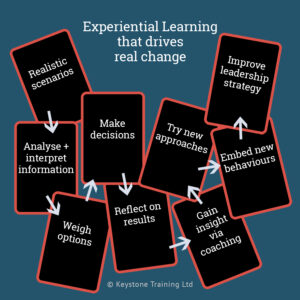
The cycle begins with a real experience. Leaders are placed in a situation where they must analyse information, make decisions and work with others to move forward.
This might involve managing competing priorities, interpreting new data or navigating uncertainty – all familiar territory if you’re operating in a leadership role.
The second stage is reflection. Participants review what happened: the decisions made, the assumptions behind them and the consequences that followed. This step often reveals patterns in thinking or behaviour that are easy to miss in everyday work.
From reflection comes insight. Your leaders begin to see how their approach influences outcomes, team dynamics and the quality of decisions.
The final stage is application. Leaders adjust their thinking and behaviour, testing new approaches the next time they face a similar challenge.
Over time, this cycle turns experience into deeper capability: learning that sticks.
Why Learning by Doing Builds Leadership Capability
Insight alone rarely translates into ongoing changed behaviour.
The difficulty is practical. You can’t always apply ideas slowly and carefully in a controlled environment. That’s for an ideal world.
In reality, your leaders are working in situations that involve uncertainty, competing priorities and incomplete information. It’s hard to take a concept from a workshop and apply sound judgement when the stakes are real and urgent.
So, this is where experiential learning creates a meaningful difference.
Instead of focusing primarily on theory, your leaders benefit more from scenarios or simulations where they must
- interpret information,
- weigh options and
- make decisions that influence outcomes.
In these environments, learning by experience becomes a real driver of development. It’s embedded in daily work.
As leaders see how their decisions affect results, strategic thinking becomes more concrete.
Accountability becomes clearer because choices carry consequences.
Team dynamics also become more visible, revealing how communication, influence and collaboration shape outcomes.
And if you’re making an investment in leadership development, this difference matters.
Anyone can transfer knowledge quickly, but judgement under pressure develops through experience. Which is why learning by doing is becoming central to many leadership programmes.
Reflection: The Link That Turns Experiential Learning into Leadership Insight
Experience alone doesn’t automatically produce learning.
What turns experience into real development is reflection, supported by feedback and thoughtful discussion. This stage is a critical part of the experiential learning cycle.
After your leaders have navigated a challenging situation, the most valuable learning often comes from examining what happened and why.
Which assumptions shaped the decision?
How did different perspectives influence the outcome?
What behaviours affected how the team worked together?
Structured reflection like this helps your leaders see patterns that might otherwise remain invisible.
And when this process is supported by coaching or facilitated discussion, insight deepens further.
Leaders begin to understand not only the results of their decisions, but the behaviours and thinking that produced those results. No blaming. No shifting responsibility.
If you’re investing in leadership development, this reflection step is non-negotiable.
Experiential learning becomes powerful not simply because leaders face realistic challenges, but because they have the opportunity to step back, analyse their approach and apply new thinking the next time a similar situation arises.
Keystone Delivers Experiential Learning That Drives Real Change
Our courses are partnerships geared to your unique business needs. We work with your leaders using real-world scenarios and simulations, coaching them to think strategically on their feet – with deep understanding based on behavioural science.
This is what makes them effective leaders who contribute to improved business outcomes for you, year on year.
If experiential learning sounds like the missing ingredient in your leadership development plans, call us to discuss your training needs. Let’s talk.
Taster Day in May: Would you like an invitation to a Leadership Simulation Taster Day in London on Tuesday 19 May 2026? Designed for Heads of HR, Heads of L&D, and senior People leaders with commissioning responsibility, the day includes:
- A one-day immersive version of our impactful leadership simulation course
- Live, personalised behavioural coaching
- Insight into where simulations sit within wider leadership strategies
Click here to register your interest: Leadership Simulation Taster Day – Register Your Interest – Fill in form

Esther Patrick is a Client Accounts Director at Keystone and a member of the Senior Leadership Team. An experienced consultant and management author, she has nearly 20 years’ experience leading client partnerships across sectors from construction to healthcare and designing leadership, culture, and team development programmes aligned with their strategic goals and values. Esther is passionate about creative, human-centred learning.