Making Your Programmes Pop – Design with Transfer in Mind
It’s possible to deliver a well-designed, engaging training programme that participants enjoy, and still see little or no change back at work.
Most organisations have experienced this at some point. The feedback is positive, people leave motivated, and the sessions feel valuable. But a few weeks later very little has shifted in how work actually happens.
Why good training doesn’t always lead
to change
The issue is rarely the quality of the session itself.
In fact, the training room often works exactly as intended. It creates space to step back from the day-to-day, reflect, learn, and practise new approaches with peers. That time away from the ‘doing’ is important.
The problem is what happens next.
When people return to work, they step straight back into the same pressures, expectations, and habits. In those moments – during a difficult conversation, a rushed decision, or a high-pressure situation – default behaviours tend to win.
People know what to do, but the environment hasn’t changed enough to support them to do it.
The gap isn’t knowledge. It’s application
Many organisations respond to this by adding more training.
But the gap is really about whether new behaviours can be accessed and applied in real situations, under pressure, with competing priorities.
That requires something different.
• Time to pause and think in the moment
• Opportunities to practise in real work scenarios
• Feedback from others who can see what’s happening
• Reinforcement over time, not just a single intervention
Without these conditions, even the most engaging programme will struggle to create lasting change.
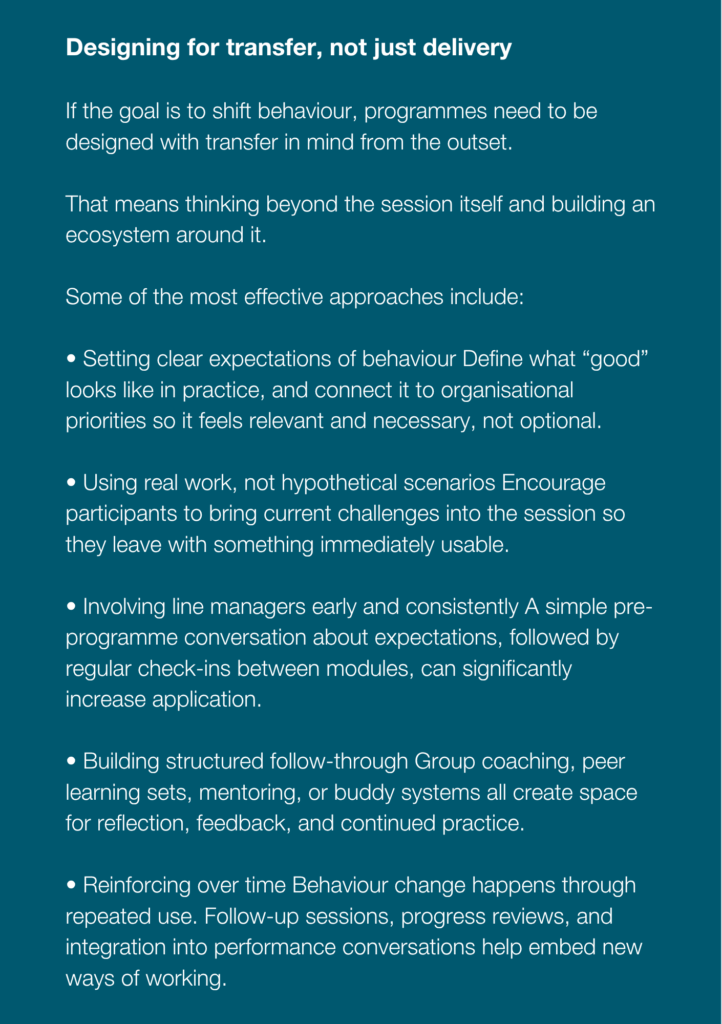
Rethinking how we measure success
This also has implications for how programmes are evaluated. Immediate feedback has its place, but it only tells you how participants experienced the session. It doesn’t tell you whether anything has changed.
To understand impact, it’s more useful to ask:
• What have people actually tried back at work?
• Which things got in the way?
• What has changed in how they handle real situations?
• What support is still needed?
These questions shift the focus from satisfaction to application, which is where the real value sits.
A more realistic view of how development
works
The training room is not the end point of learning. The real development happens in work – in conversations, decisions, and moments of pressure.
That’s where you test, refine and embed behaviours.
Programmes that recognise this, and are designed to support it, are far more likely to lead to meaningful, sustained change.
Keystone Training Ltd works with organisations to design development that goes beyond the session itself, linking leadership behaviours to real work, and building the conditions needed for those behaviours to stick.
Download this blog here – Keystone April Bulletin

Esther Patrick is a Client Accounts Director at Keystone and a member of the Senior Leadership Team. An experienced consultant and management author, she has nearly 20 years’ experience leading client partnerships across sectors from construction to healthcare and designing leadership, culture, and team development programmes aligned with their strategic goals and values. Esther is passionate about creative, human-centred learning.