Culture Change Without the Buzzwords: How Real Leaders Shape Behaviour
As a senior leader with your finger on the pulse of your business, you can usually sense when culture change is needed long before anyone names it. Something feels “not right”.
The values read well, but day-to-day behaviour doesn’t quite match.
People are polite in meetings but frustrated afterwards.
Teams are “sort of” adapting to new ways of working, but with a bit more drag than you expect.
Communication feels more strained than it should.
You realise a shift is needed because team culture matters to business success. And you know it won’t come from another presentation! Been there, done that. Buzzwords only tinker at the edges.
So – how do you transform organisational culture?
In our experience of working with many teams in different arenas, real culture change starts with what you choose to notice.
Once you start noticing smaller signals, the pattern of cultural shift becomes unmistakable.
Why Culture Change Starts With What You See
Imagine giving yourself a morning away from your usual rooms. No agenda. No formal audit. Just you, walking the floor of your organisation. Maybe outdoors, if that’s where the real work happens.
Within minutes, you hear and see things you’d never hear in boardrooms. Snide jokes. Side comments. Hesitations.
You notice how quickly some people defer to certain colleagues and how others hold back.
And you realise that this has simply become habit. Work has quietly arranged itself into a culture of its own, separate from your espoused and documented company values!
However, these shop floor details are where your real culture lives. So it’s also where your cultural transformation will have to begin.
What is Cultural Transformation?
Cultural transformation is a process that makes deep, sustained changes in how your staff work together. When what happens day by day no longer matches what you want, your culture has drifted.
So, a deliberate cultural transformation will be needed to counteract this drift.
And that’s why the time you just spent in the middle of real workflows is so revealing.
Did you notice things like:
- A meeting where half the room is alert and the other checking their phones?
- A handover that’s more about protecting people’s time than sharing insight?
- A team that seems energised despite pressure?
These observations matter. They tell you about the cultural transformation you’ll need – more than any dashboard would.
And note that third point: it’s positive! Sometimes the clearest insight comes from where things are going right, despite circumstances, even if you don’t yet understand.
Maybe you also observe what’s rewarded (despite your stated company values), what’s avoided (because personal values clash with company stated values), and what’s quietly tolerated (because it’s easier to go with the loudest).
And here’s what you might deduce from your observations:
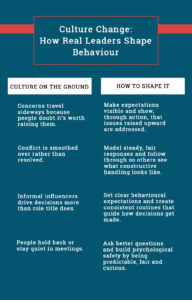
- Concerns are shared sideways instead of upwards (maybe staff feel there’s no point).
- Unofficial decision-makers have far more influence over day-to-day acts than their title deserves.
- Managers smooth over conflict instead of dealing with it (elephant-under-the-carpet syndrome).
- Decisions seem to change depending on who’s in the room. (We’ve all experienced this.)
This shows the culture you intended has gone off course. Not toxic. But definitely a red flag for you to start re-shaping behaviour intentionally as a senior leader.
Cultural transformation will then stick.
How to Turn Culture Change into Cultural Transformation
Culture subtly changes all the time. On the other hand, cultural transformation is a deliberate action of sustainable, intentional realignment – as we said.
You first demonstrate in practice what “good” is. And when people understand what “good” looks like, your workplace culture will begin to align with your business values.
The most effective leaders begin with one question: “What behaviour do I want to see more of – and what gets in the way of it right now?”
That shift – from abstract principle to observable action – is where culture change becomes transformational.
So, once you’ve identified the behaviours that matter, the trick is to anchor them into everyday work practices for long-term productivity and mental wellness in your teams.
This is the foundation of any successful cultural transformation approach.
It starts with diagnosing your business’s cultural dynamics to gain insight into what needs to change.
Perhaps you want a culture that builds psychological safety into the workplace. Or improves collaboration by increasing levels of trust in relationships. Or maybe strengthens your leaders so they manage multigenerational teams well.
Whatever your aim, you need a structured behavioural roadmap.
Once your staff know what’s expected and they see you modelling it, the pattern spreads. The positive environment makes it easy to do the right things consistently.
So, how do you model the required behaviour for long-term culture change?
Behaviour Modelling that Sustains Culture Transformation
The gap you’ve noticed between your company’s stated values and the reality is due to ambiguity. And humans seem programmed to solve ambiguity by producing their own rituals and solutions (“behaving”)!
Your job, therefore, is to remove that ambiguity. This means culture change will take shape in real time.
Here are some examples of how it works:
Make expectations visible: Show what your values look like in conversations, decisions and meetings.
Create psychological safety through consistency: Model steady and fair reactions so staff can take more constructive risks. They speak up earlier. They stop hiding problems until they’re serious issues.
Ask better questions: Questions shift behaviour much faster than instructions. “What do you need from me?” or “What’s the real barrier here?” helps people examine their own patterns without feeling called out.
Follow through: This is the key. When you act on what you’ve noticed or been alerted to – removing a blocker, supporting a manager, holding a standard – the culture starts to recalibrate around you.
The shift is subtle at first, then visible in every team interaction as they copy your lead.
None of this is dramatic. It’s an intentional shaping of the culture change you’re looking for.
Keystone Can Strengthen the Culture Change You’re Leading
There are moments when you’ve seen enough (like on your walkabout) to know where the culture needs to shift, but you’re too close to the situation to deal with it effectively.
Or maybe, you’ve noticed things miraculously improve if you walkabout – which defeats the whole point of it! This is when you may need some external support to find the clues.
Either way, a bespoke cultural transformation programme can be a great investment.
When you partner with Keystone, we help you make sense of the behaviours you’ve observed – the habits, pressures and unspoken rules shaping how people work – and turn them into clear, repeatable routines your teams can use. By practising and embedding them.
Using structured diagnostics, behavioural science insight and practical leadership tools, we help you build the consistency that keeps your culture aligned with your values.
If this sounds a helpful way forward, let’s talk.

Esther Patrick is a Client Accounts Director at Keystone and a member of the Senior Leadership Team. An experienced consultant and management author, she has nearly 20 years’ experience leading client partnerships across sectors from construction to healthcare and designing leadership, culture, and team development programmes aligned with their strategic goals and values. Esther is passionate about creative, human-centred learning.