From Insight to Impact: Measuring ROI of Leadership Development
The Return on Investment (ROI) of leadership development is one of the most persistent questions asked in senior teams.
In that context, you’re asked to approve budgets, justify spend and demonstrate commercial discipline.
It’s entirely reasonable to ask what leadership development is actually delivering beyond attendance numbers and favourable feedback forms.
Too often, the ROI of leadership development is reduced to activity metrics: how many managers attended, how satisfied they felt, whether the programme ran on time and on budget.
But none of those measures tell you whether decisions improved, whether team performance strengthened, or whether avoidable attrition reduced. They describe effort, not impact.
If you’re responsible for performance, margin or risk, you need something more robust.
You need to see how leadership and development translate into measurable shifts in behaviour and, over time, into operational and financial results.
You’re not questioning if leadership matters. You know it does. But you need to be able to trace a credible line from leadership development training to outcomes that affect your organisation’s performance.
That line exists. But it requires discipline in how you define, measure and evaluate the ROI of leadership development from the outset.
So in this article, we are going to look at the real concerns behind the questions, and at the practical ways you can evaluate whether developing leadership in your organisation is changing anything that genuinely affects performance.
The Real Concerns Behind ROI of Leadership Development
When you question the ROI of leadership development, we understand you have to exercise proper commercial oversight. If you are to position leadership development training as a strategic priority investment, it must withstand scrutiny in the same way as any other significant spend.
Here are some of the real concerns we hear behind the budget conversations:
“We’ve invested in leadership development training before. Nothing changed.”
This is perhaps the most common objection. Day-to-day behaviour remained largely the same.
In many cases, this was because no one defined the specific leadership behaviours that needed to improve in your unique set-up via training – and did not measure them before and after. So evidence was unavailable for documenting.
And without specifics and evidence, the ROI of leadership development becomes almost impossible to demonstrate.
“This feels intangible. Where is the commercial evidence?”
Leadership is often labelled as “soft”, particularly when compared with capital investment or technology spend. But the consequences of poor leadership are rarely soft. Slow decisions, unclear accountability, avoidable conflict and disengagement all carry measurable cost.
The challenge is that financial performance is a lagging indicator. By the time profit, margin or retention figures move, the underlying behaviours have been in place for months, sometimes years.
If you only look for immediate financial uplift, you will miss the earlier signals that leadership and development training is influencing operational performance.
“Margins are tight. Why prioritise developing leadership now?”
When cost pressure increases, discretionary spend is scrutinised first. We get that. And leadership development can easily fall into that category if it’s not clearly linked to business risk, productivity and employee retention.
Yet gaps in effective leadership tend to surface most sharply under margin pressure.
For example, leaders fail to clarify priorities. Skip quality checks. Impose aggressive sales targets.
In a tight environment, developing leadership is not the luxury it initially seems. It’s the key to protecting performance and reducing extra costs.
“Surely senior people already know how to lead?”
This is something of an old chestnut because it’s so tempting to equate the two. But technical competence and leadership capability are not the same.
Promotion often rewards expertise, length of employment with the company or delivering under pressure. But it doesn’t automatically equip someone with the skills they require to align teams, manage performance, navigate conflict or make balanced strategic decisions.
And those are the very skills your leaders need most in today’s world.
Without deliberate investment in structured leadership training, even senior people can struggle.
So – to secure buy-in for leadership development in your organisation, you will need to:
- Name the specific behaviours you expect to improve outcomes and
- State clearly how you will measure them. (Stakeholders understand data.)
Here’s how this looks in practice.
Measuring the ROI of Leadership Development Through Behaviour
If the concerns we listed resonate with you, the question becomes practical: how do you measure the ROI of leadership development in a way that stands up to scrutiny?
The answer is not to promise immediate profit uplift. You need to define, observe and measure the leadership behaviours that already directly influence performance – and to treat those behavioural shifts as leading indicators of commercial results.
Define the behaviours that actually move performance
Before any leadership development training begins, you need to clarify what must change.
Not generic competencies. Not abstract values. Observable actions.
For example:
- How quickly are operational decisions made and communicated?
- How often are issues escalated unnecessarily?
- Do managers hold structured performance conversations with clear objectives and documented next steps?
- Are cross-functional disagreements resolved constructively, or do they stall projects?
In manufacturing, this may show up in reduced rework or fewer safety escalations.
For professional services, it may mean clearer delegation and improved margin discipline.
Within healthcare or public sector environments, it may translate into better coordination and fewer avoidable delays.
If you cannot describe the behaviours you expect to see more of – or less of – the ROI of leadership development will remain theoretical. And proposals for training will be rejected.
Establish a baseline before developing leadership
You cannot evidence improvement without a starting point.
Before developing leadership capability, establish a baseline using methods proportionate to your organisation:
- Targeted 360 feedback focused on specific behaviours.
- Short pulse surveys linked to managerial clarity and accountability.
- Operational data such as decision turnaround time, escalation rates or regretted attrition within defined teams.
- Observation of meeting effectiveness: are decisions taken, owners agreed and follow-ups tracked?
This is about having something to compare with. Without a baseline, you can’t credibly demonstrate to senior colleagues the impact of leadership and development initiatives.
Re-measure and link to operational outcomes
After the intervention, re-measure the same behaviours at agreed intervals. Then examine whether operational indicators shift in parallel.
You may see reduced decision latency, fewer unnecessary escalations, improved engagement scores within specific teams, or lower regretted attrition among high performers.
Over time, those behavioural and operational improvements should influence financial metrics.
Bear in mind that behaviour change is a leading indicator. Financial performance is a lagging one.
If leaders make clearer decisions, set stronger expectations and manage performance consistently, you should expect cost, productivity and retention indicators to follow.
This is where the ROI of leadership development becomes visible. Not because a workshop took place, but because leadership capability changed in ways that alter how work gets done.
Measuring the ROI of Leadership Development: From Behaviour to Business Value
If you want the ROI of leadership development to withstand scrutiny, you will have to make the link explicit to all stakeholders.
Leadership development training on its own doesn’t create value. What creates value is the change in how your managers lead day to day.
When those behaviours shift, the operational consequences follow. And over time, those operational improvements influence cost control, productivity, retention and margin.
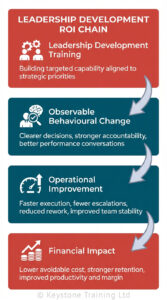
That’s the chain you need to be able to articulate. If any link in that chain is weak, the ROI of leadership development is rightly questioned. But if you deliberately design and measure the links, your argument becomes credible.
For you, as a senior decision maker, it’s crucial to treat leadership and development issues with the same discipline as any other strategic investment.
When you define the behaviours that drive performance, establish a baseline, re-measure consistently and connect the findings to operational data, you move the conversation from aspiration to evidence.
If you approach developing leadership in this way, you’re not funding a morale exercise! You’re strengthening a behavioural capability that’s central to sustained performance and competitive advantage.
Keystone Can Make the ROI of Leadership Development Work in Your Context
If you’d like our help to make the link between improved leadership behaviours and your ROI, we’re happy to discuss your commercial needs and how to develop sustainable leadership skills – and design bespoke training that sticks. Give us a call today and let’s talk.
If you would find it useful, we’ve created a short Leadership Development ROI Planning Framework to help you define behaviours, establish baselines and link development to measurable outcomes. It’s designed for use in budget and planning discussions.
Click to download the framework PDF (opens in a new window)

Esther Patrick is a Client Accounts Director at Keystone and a member of the Senior Leadership Team. An experienced consultant and management author, she has nearly 20 years’ experience leading client partnerships across sectors from construction to healthcare and designing leadership, culture, and team development programmes aligned with their strategic goals and values. Esther is passionate about creative, human-centred learning.