Learning That Sticks: Why Leadership Development Fails Without Real World Application
Have you noticed how your leadership development programmes always look successful on the day? The training seemed to go well, and everyone was ‘satisfied’ or ‘extremely satisfied’.
Yet a few weeks later, the actions participants committed to doing are already fading. Within months, the impact of the programme has all but disappeared.
You’re not alone. And it’s not a reflection on your commitment to leadership development.
We hear about this kind of situation from many senior leaders in all industries. Under pressure, familiar patterns reassert themselves all too quickly.
There are ways to bring about the change you’re looking for – training that translates into lasting top-rate leadership behaviour. But let’s pause a moment to review why training often fails to stick.
Why Leadership Development Often Breaks Down
Most leadership programmes are designed to inspire. They:
- Introduce models.
- Explore best leadership qualities.
- Create moments of insight.
But inspiration alone doesn’t change behaviour. If only!
Your leaders need real-world application of the material within the training – practising how to manage meetings, hold difficult conversations, make decisions and deal with daily uncertainty.
If learning remains abstract, your leaders inevitably default to habit. Many examples of leadership failures come from leaders reverting to familiar behaviours when the pressure is on.
That’s simply a predictable outcome of humans trying to learn complex behavioural skills in a one-off session without the necessary practice to embed the skills.
Without practice, reflection and reinforcement, leadership qualities stay theoretical. We’ll examine those ingredients, as they’re crucial elements of effective leadership development.
But there’s also a business cost when those programmes you bought fail to deliver on their promises…
The Cost of Leadership Development That Doesn’t Transfer
From your organisation’s perspective, leadership and development initiatives that fail to stick create hidden costs:
- Time is taken away from operational priorities when you have leaders who are technically competent but lacking essential people skills (maybe they were promoted from inside without leadership training).
- Leaders’ credibility is lost when training doesn’t match reality (employees are quick to spot this).
- Without effective training for your leaders, your business will suffer (yet future investment becomes harder to justify as the balance sheet shows no gain).
The thing is, when leadership development training produces only short-lived insight without useful application, it becomes hard for you to defend it as a serious business investment.
So – let’s look now at the ingredients that change the training saga into a blockbuster.
What Actually Changes Leadership Behaviour
Exposure to content alone will not develop leadership skills. You’ve seen this. If the real question is how to develop leadership skills that hold up in the workplace, the answer lies in practice, reflection and reinforcement – not more information.
And the key is using that content in practice – as new behaviours – in situations that resemble a leader’s real-world work, with reflection, and also reinforcement over time.
This is where blended learning is effective. Not as yet another format, but as a process.
Blended Learning Defined by Impact, Not Format
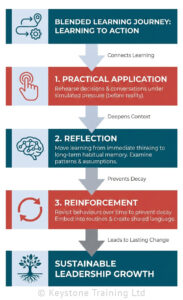
Blended learning is often seen as a mix of delivery methods, but in leadership development it’s better understood as a structured journey that connects learning to action.
Seen as a journey, strong leadership development training deliberately blends the three elements we mentioned earlier: practice, reflection and reinforcement.
This approach recognises that developing leadership skills is a process.
Each element on the process addresses a specific failure point in traditional approaches and leads to effective leadership back in the workplace.
Practice: Making Leadership Learning Practical Enough to Use
The first requirement is practice that reflects real leadership pressure. Leaders work in pressured environments. Always.
They need opportunities in advance to rehearse the conversations, decisions and judgements they’ll be expected to make under pressure back at work.
This might involve realistic scenarios, simulations, or experiential approaches – such as drama-based learning, where appropriate.
The value lies in surfacing instinctive responses and testing alternatives in a safe environment.
An off-site group setting helps achieve this, as no one is individually put at risk of feeling exposed in their usual workplace setting.
And when leadership practice mirrors reality, leadership qualities start becoming observable behaviours. This is a tangible result rather than a theoretical one.
Reflection: Why Reflection Accelerates Leadership Development
However, our experience at Keystone is that practice alone is not enough to produce effective leaders for you.
Learning remains fragmented if there’s no time for reflection. You have to move learning from the immediate thinking brain to long-term habitual memory.
Structured reflection allows this to happen. Leaders examine what influenced their behaviour, which assumptions were at play, and what patterns are emerging. This gives context to a given skill and lodges it in long-term memory.
Again, reflection works best outside the immediate workplace.
In a blended training environment, your leaders can step back from operational demands and urgency, and have time to examine their behaviour.
In this way, group reflection exposes blind spots, normalises challenge and accelerates learning in ways that isolated self-reflection cannot.
This reflective space is not a “soft” add-on! It’s behavioural science in action – a mechanism for improving judgement, consistency and self-awareness across leadership populations.
Our last point is about reinforcement…
Reinforcement: Where Most Leadership Development Fails
Reinforcement is the most neglected element of leadership development. Even strong programmes often assume that once learning has occurred, behaviour will follow.
In reality, behaviour decays quickly without reinforcement. It takes many days of consistent application to embed a behaviour change – even one that’s fully accepted.
Organisational pressure, time constraints, and legacy habits all pull your leaders back towards familiar patterns. The old habit kicks in, and the horse bolts before the gate can be closed again.
So – what does that mean in real terms?
Reinforcement means revisiting behaviours over time, embedding leadership expectations into everyday routines, and creating shared language around leadership qualities.
It may involve follow-up sessions, peer accountability or manager involvement – but reinforcement must be intentional.
This is where blended learning proves its value. It recognises that effective leadership development means sustaining behaviour over time until it’s second nature.
When Leadership Development Starts to Deliver Organisational Impact
When practice, reflection and reinforcement work together, leadership development starts to produce measurable results:
- Behaviour becomes more consistent.
- Decision-making improves.
- Fewer leadership failures occur due to avoidance, ambiguity or reactive responses.
For you, the shift will become visible. Your teams will operate efficiently within a group culture that brings sustained payoff in terms of improved results.
Keystone Can Help with Effective Leadership Development That Sticks
At Keystone, we treat leadership development not as a set of ideas to be understood, but as a capability to be built and maintained. It’s what we’re passionate about.
If you want learning that translates into consistent leadership behaviour, our expertise lies in helping organisations across a range of sectors design development training that works. We embed practice, reflection and reinforcement so learning doesn’t stop when the programme ends.
If you’d like us to partner with you to design bespoke training that will equip your leaders long-term, give us a call today and let’s discuss your unique needs.
Taster Day in May: Would you like an invitation to a Leadership Simulation Taster Day in London on Tuesday 19 May 2026?
Designed for Heads of HR, Heads of L&D, and senior People leaders with commissioning responsibility, the day includes:
- A one-day immersive version of our impactful leadership simulation course
- Live, personalised behavioural coaching
- Insight into where simulations sit within wider leadership strategies
Click here to register your interest: Leadership Simulation Taster Day – Register Your Interest – Fill in form

Esther Patrick is a Client Accounts Director at Keystone and a member of the Senior Leadership Team. An experienced consultant and management author, she has nearly 20 years’ experience leading client partnerships across sectors from construction to healthcare and designing leadership, culture, and team development programmes aligned with their strategic goals and values. Esther is passionate about creative, human-centred learning.