Leadership Training in Q1: Resetting Expectations
The start of Q1 is often when leadership training stops being a strategic aspiration for your company and becomes an imperative. But you may be wondering, why now?
After year-end transitions, shifting business priorities or organisational change, you need your managers to be competent at resetting expectations for the year ahead.
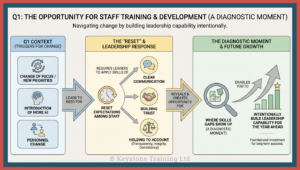
It quickly becomes evident if they have the necessary skills to:
- Clearly communicate the changes
- Build trust throughout the change management process
- Hold their staff to account
If you notice unclear expectations, inconsistent conversations or accountability slipping, it’s usually a signal leadership development is lagging.
In other words, the skills your managers need to lead confidently through change are not yet embedded.
Of course, Q1 doesn’t create these gaps. It simply exposes them, giving you a clearer view of where leadership capability needs strengthening for the year ahead.
In practice, we often find this is a positive moment. Because when you understand what’s happening, you can take action.
But first, let’s backtrack and review the what and the why. It’s worth a closer look because unresolved leadership effectiveness issues tend to compound – and that costs you in the longer term.
Why Leadership Development Is Tested When Business Expectations Change
Periods of change place immediate demands on your leaders.
Your business priorities have adjusted, ingrained assumptions need to be challenged, and your people are looking for clarity.
In these moments, you see how your leaders frame direction and respond under pressure.
Some will successfully reset expectations. They’ve translated intent into clear action.
When they don’t, teams default to mixed interpretations, uneven standards and quiet frustration.
However, this is simply a capability gap you can rectify.
Points of transition, such as at new year, always show up leadership skills gaps if they exist.
These skills your leaders need after change or realignment are not innate: they all have to be developed deliberately and reinforced over time.
They include communication, trust-building and accountability strategies to enable the changes to work effectively.
We’ll look at them in turn.
Clear Communication and Leadership Skills Training
Unclear leadership conversations are the bane of teams.
Clear communication helps your leaders frame what matters, explain why it matters and reinforce it consistently.
You’re asking your managers to…
- cascade priorities,
- explain new ways of working,
- respond to uncertainty…
…sometimes all at once.
End result: stability during change. Which is what you wanted.
But when leaders lack confidence or structure in these conversations, teams make assumptions and your new reality drifts off course.
Without effective leadership skills training, many managers will find handling these conversations difficult.
So, enabling leaders to practise communicating with clarity is a core part of effective leadership training and development – especially when your organisation is under pressure.
But where does trust fit in? Trust leads to acceptance of change, and it’s built via consistency…
A Leadership Training Challenge: Build Trust Through Consistency
For staff to accept and survive change, they need to trust your leaders.
But trust erodes when leadership behaviour becomes inconsistent.
Here’s a scenario…
You’ve brought in new rules, new structures, maybe even some AI agentic processes. After any such changes to their routines, teams watch closely.
They notice whether leaders enforce priorities or quietly drop them, whether standards apply to everyone, and whether there’s consistent follow-through on decisions.
Inconsistent leadership behaviour, even when unintentional, creates uncertainty and hesitation.
It’s obvious. Leaders under strain revert to familiar habits, particularly if they haven’t had the opportunity to practise leading through major changes.
On the other hand, leadership management training that focuses on real situations – not abstract models – helps your leaders and managers build the confidence to act consistently, even when conditions are unsettled.
And when people know what to expect from their leaders, trust grows.
But consistency is a learned skill that needs practice in a safe environment.
And then there’s accountability…
Accountability Breaks Down When Leadership Capability Is Uneven
Accountability is often treated as a performance management issue. In reality, it’s a leadership capability issue.
And it matters most when you want to reset expectations after change.
When expectations aren’t clear or leaders feel uncomfortable addressing underperformance, accountability becomes uneven.
Some of your managers may avoid difficult feedback conversations altogether.
Others may apply standards inconsistently, creating confusion and resentment within your teams.
Effective leadership training supports your leaders to hold people to account without damaging trust.
It equips them to have balanced, confident conversations that reinforce expectations while maintaining engagement.
If they don’t have this capability, accountability quietly slips away and your Return on Investment (ROI) suffers.
So – if you’re seeing ownership weaken or standards applied unevenly, it’s worth asking whether your leaders have had the development opportunities they need to lead these conversations well.
Quarter 1: A Diagnostic Moment in Leadership Training and Development
A common concern at this point is timing. If leadership gaps are showing up in Q1, is it already too late? (Think: shutting the gate after the horse has bolted!)
In practice, however, Q1 is not about fixing everything immediately.
This period provides a clear diagnostic moment, revealing where your leaders’ capabilities are strong and where they need strengthening.
That’s a bonus. Because the patterns that emerge now often repeat throughout the year if left unaddressed.
So offering leadership development at this stage is strategic from your business ROI point of view.
It allows you to use what Q1 reveals to prioritise development that will have impact well beyond the first quarter.
Think of it as checking the roof tiles and mending loose window frames before the next storm arrives. You’re building capability intentionally.
Turn Insight into Action Through Leadership Training and Development
When you’re responsible for training and leadership capability, the challenge is where to focus that training so it lands effectively.
After a period of change, the most effective leadership training and development will focus on leadership skills. Those around setting expectations, reinforcing priorities, building trust and holding teams to account.
This makes change manageable for everyone.
Our best advice is to ensure leadership development is aligned to your real organisational challenges – for example, through immersive leadership simulation training. You want the returns to become visible in your unique business world.
Keystone Leadership Training Courses Can Help Strengthen Your Year Ahead
If the start of the year has highlighted uncertainty, difficult change management or inconsistent leadership behaviour, it’s worth seeing those signals for what they are: information (or to coin a phrase, intel!).
It also makes sense to equip your leaders now with the leadership skills training they need for whenever change demands it. In the current economic climate, that’s pretty often!
At Keystone, we base our leadership development programmes on your unique practical needs, working in partnership with you – but also within behavioural science principles.
Bespoke, high-impact training delivers the leaders you’re looking for.
If this sounds useful to you at the start of the year (or any time!), let’s talk.

Esther Patrick is a Client Accounts Director at Keystone and a member of the Senior Leadership Team. An experienced consultant and management author, she has nearly 20 years’ experience leading client partnerships across sectors from construction to healthcare and designing leadership, culture, and team development programmes aligned with their strategic goals and values. Esther is passionate about creative, human-centred learning.