Psychologically Safe Workplace: The Missing Skill in Middle Management
Like most organisations that genuinely want to operate a psychologically safe workplace, you want to encourage people to speak up, share ideas and learn from mistakes. Yet in practice, day-to-day interactions between middle managers and their teams don’t reflect that ideal.
The reason is that managers have a difficult job – to challenge both performance and behaviour without sounding threatening, personal or unsafe. And many have never been given the skills to do that well.
Faced with this tension, your managers often soften feedback, delay difficult conversations or avoid them altogether. Over time, what was meant to be a psychologically safe workplace becomes one where important things simply go unsaid.
You probably recognise the struggle to ask your middle managers to do emotionally and relationally complex work. It’s not easy.
But if you can supply them with the missing skills to do it safely, the impact will be felt not only in culture, but in performance and return on investment (ROI) over time.
Let’s dig into this a bit more, because it’s crucial to your business growth in 2026.
Building a Psychologically Safe Workplace Starts with Middle Management
Although you, as a senior leader, decide you want to operate a psychologically safe workplace, it’s your middle managers who carry the responsibility for making it happen. They’re key to its success or failure.
What is middle management in this context?
It’s a bridge. Middle management acts as the link between senior management’s intent and your employees who bring it into being – whether that’s inside a building or out in the field.
The middle manager is therefore also the one who has to give challenge and feedback about performance and behaviour.
So, in practice, how your managers exercise their role affects everything downstream.
Done badly, psychological safety weakens (no one speaks up, no one admits mistakes). But done well, managers build a psychologically safe workplace that inspires learning, innovation and improved performance.
That’s why, in our experience, middle management is your critical starting point for workplace wellbeing.
Why Psychological Safety Breaks Down When Challenge Feels Too Risky for Middle Managers
Think about it like this: you want your managers to routinely challenge performance and behaviour while also keeping teams engaged and motivated.
Most people would feel that’s a risky situation to be in!
Your managers probably know what needs addressing. But it takes excellent skills and some safe, offline practice to know how to raise issues without triggering defensiveness, disengagement or conflict.
Behavioural feedback, in particular, carries an additional perceived risk. It can feel personal, even when it’s not meant to. Without clear skills for separating behaviour from identity, many of your managers will err on the side of caution.
This means they’ll either avoid giving feedback – or it will be too indirect, too late to be of use, or too soft to have lasting impact.
Over time, this aversion to risk-taking creates a predictable pattern:
Your teams discuss issues in general terms rather than directly. Standards become inconsistent. And employees learn what’s safest to say, not what most needs saying.
Your business still champions a psychologically safe environment, but the workplace doesn’t show it in practice. The reason is that risk outweighs confidence – because a key middle management skill is missing.
The Missing Skill That Creates a Psychologically Safe Environment
A psychologically safe workplace depends on a specific, learnable management skill.
At the core is the ability to challenge ideas and behaviour without creating threat. That includes:
- describing observable behaviour rather than assumed intent
- being clear about impact without assigning blame
- regulating tone when pressure is high
- inviting response without losing authority
When managers lack this skill, even well-meaning feedback can feel ambiguous or unsafe. When they have it, any challenge or feedback they give becomes clearer, more contained and easier to receive.
Handling these difficult conversations skilfully, consistently and without escalation is what creates psychological safety.
In addition, two important business outcomes evolve – over time – when your middle managers have the skills to create a psychologically safe environment.
One is the growth of the overall business culture you want. And the other is improved performance and ROI, as we mentioned up top.
We’ll talk about those two points next, but here’s a visual chart of the sequence.
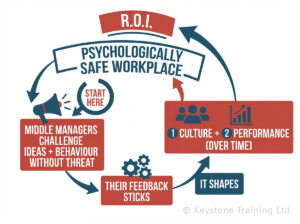
1 When Feedback Sticks, Culture Starts to Shift
Feedback only shapes behaviour when people absorb and act on it. For that, you need enough psychological safety for people to reflect rather than react defensively.
When middle managers have the skills to address challenges and give feedback with confidence, clarity and emotional control, team behaviour gradually changes.
People begin to understand that challenge and feedback are part of learning – which normalises speaking up, questioning assumptions and addressing issues before they become endemic.
Over time, this brings a culture shift, reinforcing a psychologically safe workplace as ‘how we do things’. And the bonus is less employee turnover and more team engagement.
2 Creating a Psychologically Safe Environment Leads to Performance Improvements
You’ll find that your psychologically safe workplace culture also supports better performance.
With highly trained middle managers in charge of your daily operations and a culture of safety, everyone’s output slowly improves. Teams learn from feedback, raise issues early and discuss options confidently.
For you and the other senior leaders in your organisation, this is where psychological safety moves beyond culture and into commercial advantage.
Reducing employee disengagement or friction in the workplace brings you a real cost benefit.
And it’s not wrong to think on these lines.
After all, you need to run a viable business. Caring for your employees’ wellbeing matters. But happy employees also want to be proud of working productively for a successful organisation. Psychological safety in the workplace is a competitive advantage.
Keystone Can Help Your Middle Managers Lead a Psychologically Safe Workplace
What we’ve pointed out in this article is a capability gap. Most middle managers want to do well. The good news is that handling difficult conversations safely and effectively is a skill they can learn. Training therefore makes sense as a worthwhile investment for your key middle management tier.
And as always, if you ask us to help with middle manager training, we gear it to your exact company needs and ethos. We partner with you to make sure the bespoke course hits the mark for you and drives performance.
Based on behavioural science and the real-world scenarios your managers deal with daily, our training is practical and immersive to ensure management skills stick long term.
If this sounds beneficial for your middle managers, contact us and let’s talk.

Esther Patrick is a Client Accounts Director at Keystone and a member of the Senior Leadership Team. An experienced consultant and management author, she has nearly 20 years’ experience leading client partnerships across sectors from construction to healthcare and designing leadership, culture, and team development programmes aligned with their strategic goals and values. Esther is passionate about creative, human-centred learning.