Skills of Leadership: 7 Signs Your Leadership Team is Holding Back Business Growth
Weak skills of leadership most often occur in decision-making, accountability, behaviour, consistency, delegation, poor retention of team members, and ownership of tasks. All these affect your revenue and hold back your business growth.
But the signs of weak leadership skills usually show up in day-to-day performance.
If several of the following signs keep appearing, it’s probably not a structural or process problem but a leadership issue.
Skills of Leadership: 7 Signs Your Business May be Noticing
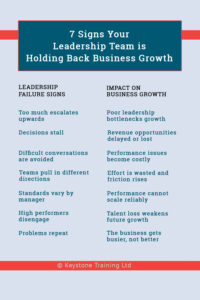
1. Too Much Still Lands on Senior Leaders
You find yourself – or your senior team – pulled into issues that someone should have resolved further down. Routine problems escalate to you. Decisions are deferred upwards. Managers bring questions rather than answers.
This points to gaps in leadership skills further down.
The impact on growth is immediate. Your senior people remain tied up in operational detail instead of focusing on strategy and business development, including the kind of strategic business development work that actually drives your business forward.
2. Decisions Drag and Meetings Keep Going Round in Circles
You know the pattern. Someone raises an issue. There’s a meeting. People talk it through. Then nothing happens.
The same topic comes back the following week. Projects sit waiting for sign-off. Client responses are delayed. Managers hesitate because no one has made a clear final call.
This is where weak skills of leadership show up in a very practical way. When your leaders and managers don’t make decisions clearly, your business slows down around them.
The operational impact is immediate: work stalls, teams wait, deadlines slip and frustration builds.
The growth impact follows quickly. Opportunities are missed, delivery becomes less reliable, and your business starts to feel harder to move forward than it should.
3. Managers Avoid Difficult Conversations
Your managers and leaders can see the problem — but still avoid addressing it. So they leave behaviour issues too long. And standards gradually become lower because no one calls it out directly.
Most leaders know that holding these difficult conversations is important. But they’re human, and many lack the confidence or capability to handle them well.
The result is predictable. Problems become more time-consuming to fix. Strong performers lose patience. Everyone’s expectations become unclear. Teamwork suffers.
This is one of the clearest gaps between average managers and the qualities of a good leader – and it has a direct effect on your business performance.
4. Different Teams Are Pulling in Different Directions
You hear different messages and priorities depending on who you ask.
One manager pushes speed. Another pushes cost control. Another says quality matters most. Commercial teams promise one thing, while operational teams are set up to deliver something else.
This is a leadership issue.
Your leaders and managers are not aligning people clearly enough around what matters most to your business goals. The result is confusion about what “good” actually looks like from one part of the business to another.
The operational impact is costly when poor skills of leadership lead to rework, duplicated effort, mixed priorities and avoidable friction between teams.
The growth impact is just as real. It becomes much harder to scale when different parts of the business are not working to the same agenda.
5. Standards Depend on Which Manager or Leader is in Charge
One team runs well. Another struggles with the same kind of work.
One manager tackles poor behaviour quickly. Another lets it drag on. One keeps deadlines, quality and accountability tight. Another allows standards to slide.
That kind of inconsistency shows that leadership skills vary too much across your business. In fact, leadership and behaviour standards have become divorced.
The operational impact is obvious. Teams perform unevenly. Quality dips in some areas. Customer experience, compliance or even safety can start to vary depending on who’s leading.
And that creates a growth problem. You can’t scale confidently if performance changes from team to team simply because the standard of leadership does.
6. Your Best People Are Getting Fed Up
You start to notice frustration among your stronger people.
Some leave. Others stay but disengage. This is often called quiet quitting. They see poor performance going unchallenged or decisions being delayed and lose confidence in how your business operates.
This is another leadership issue.
Great leaders create clarity, fairness and momentum. When that’s missing, your best people are often the first to feel it – and the first to act on it.
The cost to your business, both financially and operationally, can be significant. Replacing capable people is expensive. Losing them while weaker management remains in place is even more damaging.
7. Problems Keep Repeating Because No One Learns From Them
The same issues keep coming back. Everyone deals with them in the moment – but nothing really changes afterwards.
This is a leadership issue. Your leaders and managers need to understand how to stop the same problems happening again. And take action.
The operational impact is obvious. Time gets wasted. Teams repeat avoidable mistakes. Frustration builds because people keep tripping over the same issues.
And that creates a growth problem. Growth depends on your business becoming more capable over time. If the same problems keep repeating, your business gets busier – but not stronger.
What These Signs are Really Telling You About the Skills of Leadership
Individually, any one of these issues might seem manageable. Together, they point to something more structural.
They suggest that your organisation may not yet have the leadership capability required to support its current size – or the strategic growth you’re aiming for.
This can mean you reach a plateau. You may already have a growth strategy in place. But execution starts to suffer when it depends on leaders and managers who haven’t yet developed the skills to deliver it consistently.
Put bluntly, leadership capability may now be one of the main things holding your business back.
That’s why many organisations begin to look seriously at business development courses or broader leadership development programmes at this stage. Not as a generic training exercise, but as a way to strengthen how leadership actually works day to day.
Developing the Skills of Leadership to Support Business Growth
If you’ve recognised several of these signs, the question is: have your managers had the opportunity to develop the skills of leadership needed for the next stage of your business?
That includes:
- making decisions at the right level
- holding clear accountability
- managing performance and behaviour consistently
- aligning teams around shared priorities
- building ownership rather than dependency
These are practical skills of leadership that shape how your business runs every day.
And they’re exactly where targeted leadership development can make a measurable difference.
If your organisation is starting to feel the strain of trying to grow but feeling held back, investing in leadership capability has immediate business impact. The earlier the better for your balance sheet!
Keystone Specialises in Bespoke Skills of Leadership Training
As we’ve shown above, bespoke leadership skills training can make a measurable difference to how easily your business pulls together towards your growth goals. If you’d like us to partner with you to design bespoke training that will equip your leaders long-term, give us a call today and let’s discuss your unique needs.
If you would find it useful, we’ve created a short Leadership Development ROI Planning Framework to help you define behaviours, establish baselines and link development to measurable outcomes. It’s designed for use in budget and planning discussions.
Click to download the framework PDF (opens in a new window)

Esther Patrick is a Client Accounts Director at Keystone and a member of the Senior Leadership Team. An experienced consultant and management author, she has nearly 20 years’ experience leading client partnerships across sectors from construction to healthcare and designing leadership, culture, and team development programmes aligned with their strategic goals and values. Esther is passionate about creative, human-centred learning.