Why Early Investment in Company Culture Delivers More Consistent Wins Over Time
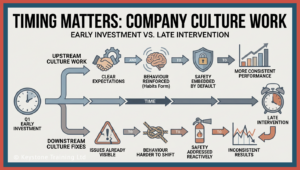
The signals you send out as a senior leader in Q1 about behaviour, priorities and expectations will set the default for your company culture all year. And reinforcing them can quickly become a competitive advantage.
Your “this year we will…” turns into operational reality.
In other words, what you choose to invest in now – standards, development, shared ways of working – gets embedded while your teams’ attention is high and habits are still forming.
The reason early investment in company culture delivers more consistent wins over time is because your teams are immediately clear on:
- What matters
- How decisions are made
- What’s genuinely non-negotiable
They then perform more effectively under pressure, adapt faster to change and make fewer costly mistakes as the year unfolds.
This begs the question: what exactly do we mean by company culture?
What Is Company Culture – and Why It Drives Consistent Performance
When leaders ask what is company culture, the answer often points them towards value statements or engagement scores. In practice, it’s much simpler.
Company culture is what shows up in everyday behaviour:
- How people make decisions when information is incomplete (shrugs – “I’ll just do it”)
- How risk is handled (“It’s worth a punt”; “No one’s looking”)
- How challenge is voiced (“I might be wrong, but…”)
- What happens when priorities compete (“I’ll prioritise whoever shouts loudest”)
It’s what people do when no one’s watching – and what they assume is expected of them when there’s no clarity.
Looking at it like this explains why culture directly affects performance – and therefore your competitive advantage.
Clear, well-embedded cultures reduce friction, speed up decision-making and improve accountability.
Unclear or inconsistent cultures do the opposite – introducing hesitation, duplication and avoidable risk.
Why Early Investment Helps Improve Company Culture
Efforts to improve company culture are often reactive. They begin after issues emerge: missed targets, rising turnover, safety incidents or visible disengagement. That’s too late.
Of course, “better late than never”. But earlier investment changes that cultural dynamic.
Why? Because Q1 is when expectations are most visible and behaviour is most open to shaping. It’s when you set the tone for how the year will actually be lived, not just planned.
By acting early, you move the work of culture change upstream. You establish clearer defaults from the outset.
This makes alignment to your business goals easier – and brings more consistent wins across the year.
How Company Culture Types Shape Behaviour Under Pressure
Let’s now take a brief look at some well-established descriptions of company culture.
They’re important because they’re relevant to why we at Keystone emphasise safe culture as the key to achieving business goals with less friction.
Most organisations lean – consciously or not – towards familiar company culture types: clan, adhocracy, market or hierarchy.
Each brings strengths, and each introduces predictable risks. You can probably imagine how some of these work.
Clan describes a healthy family vibe but comes with the risk of fun winning out over work.
Adhocracy encourages innovation and flexibility, but can risk ROI if the balance tends towards disorganised.
Market culture can sound ruthless, with goals and growth the main aim. But there’s a risk of conflict and perhaps some dishonesty in reporting.
Hierarchy describes a traditional model of control and strict job responsibilities. The risk is lack of communication between “levels” of staff – always a drawback.
But what matters most in company culture?
Rather than labels, watch how your team’s culture behaves under pressure. If you take the types in turn, you can ask:
Does collaboration slip into avoidance? Does pace override safety? Does structure provide clarity when decisions matter most? Or does hierarchy silence challenge?
Addressing such issues early helps you prevent small cultural tendencies from becoming operational problems later on.
And promotes a safe culture.
Why Safe Company Culture Creates a Competitive Advantage
As we said, the key to success is embedding psychological safety in your team culture.
A safe company culture does involve caution and compliance. But it also needs clarity, trust and shared responsibility. Particularly when pressure mounts at a crucial business moment.
When your teams operate within a culture of safety, they’re confident about speaking up, challenging assumptions and escalating concerns early.
This reduces your operational risk. Teams make better decisions and can prioritise delivering results while avoiding unnecessary disruption. And it applies whichever vertical you’re in.
Over time, this consistency becomes your competitive advantage.
If your organisation can embed a strong safety culture early in the year – led by your leaders – you’ll experience fewer shocks due to toxic team management, and recover faster from setbacks.
The end result is more reliable delivery against your business goals. Which is why cultural awareness training is often a wise choice to help embed your desired culture and deliver those goals.
The Role of Cultural Awareness Training in Sustaining Culture
Culture doesn’t auto-embed after you explain your business values. If only it were so easy!
Reinforcement is what’s needed. (Think supporting your concrete mix with iron rods.)
Cultural awareness training is like those rods. Because it’s experiential, dynamic and high-impact, the development sticks. Your teams recognise how culture shows up in real decisions and interactions. Theory becomes something they can recognise in their behaviour.
We’re not talking about magic.
The power of this kind of training is that it gives your staff a shared language for discussing behaviour, assumptions and risk – and helps your leaders and managers reinforce your expectations consistently. All year.
And it keeps culture visible, discussable and relevant as your priorities shift through the year.
Aligning Company Culture With Business Goals From the Start
Culture and performance are not separate conversations. When you align your company culture with your business goals, you ensure your targets are supported by the behaviours required to achieve them.
That’s why we said early investment in company culture brings you more consistent wins over time.
Keystone Can Help Embed Company Culture for the Long Term
At Keystone, we’ve seen that a positive team culture is the foundation of any business success. Our team culture training programmes combine behavioural science, leadership expertise and creativity to embed practical, everyday habits into a winning business culture.
It’s the difference between off-the-shelf “knowledge training” and what makes behavioural change actually happen.
If you’d like us to partner with you to help shape a positive workplace culture in your industry or business, let’s talk.

Esther Patrick is a Client Accounts Director at Keystone and a member of the Senior Leadership Team. An experienced consultant and management author, she has nearly 20 years’ experience leading client partnerships across sectors from construction to healthcare and designing leadership, culture, and team development programmes aligned with their strategic goals and values. Esther is passionate about creative, human-centred learning.