Why Managers Avoid Feedback – And How Behavioural Science Fixes It
You’ve probably noticed this: some of your managers avoid feedback even when they understand how important it is. You know they care about the work their team does. And you know they agree about feedback. But it’s not happening.
As a senior leader, you’re probably puzzled, frustrated or even a bit annoyed. And you want solutions. Fast.
Experience tells you that when feedback becomes something people tiptoe around, performance goes downhill. Small issues start to loom large, and your teams quietly lose their edge.
So what’s going on here?
The truth is that feedback becomes a problem because the psychology involved makes it harder than it looks.
In this article, we’ll explain why that is – and also where behavioural science can help you solve the issue.
Why Managers Avoid Feedback
If you’ve ever wondered why otherwise capable managers hold back on receiving and giving feedback, the reasons are almost always human ones.
People naturally try to avoid risky situations.
Managers worry someone will get defensive, upset, or disengaged the moment they hear something difficult. There’s also the discomfort of a “difficult conversation” or the awkwardness of giving feedback to someone who may have been a peer.
People avoid giving feedback because they don’t feel equipped.
Many managers haven’t had meaningful training around specific coaching skills for managers. Framing feedback constructively then feels like guesswork. I don’t have time becomes a convenient cover for I don’t feel confident.
Culture plays a role too.
In some businesses, even senior leaders rarely give or ask for feedback, so managers learn that silence is OK. And probably safer.
But over time, avoiding feedback stops feeling like avoidance and starts feeling normal. And there’s a cost to that.
The Quiet Cost of Avoiding Feedback
When managers avoid feedback, clarity disappears. People start interpreting silence as approval (no one objected), confusion (I think so, but perhaps not?) or criticism (obviously I got it wrong).
If this continues, your teams lose momentum.
- High performers don’t get the reinforcement they need.
- Struggling employees drift further off course because no one intervenes early enough.
- And managers end up storing months of unspoken observations that eventually come out all at once – usually badly expressed.
Avoidance also blocks your ability to shape cultural change in your business. Why? Because timely feedback, given well, is at the core of a strong workplace culture.
So what can be done when managers avoid feedback routines?
Let’s look first at why the approaches to feedback in the past have been so uncomfortable for everyone.
Why Traditional Approaches to Feedback Don’t Work
If you worked your way up through six-monthly or annual reviews, you already know the limitations!
They increase stress and reduce transparency because they rely heavily on personal impressions, unconscious bias, and recency effects (ignoring previous successes).
And as you know, by the time this review comes round, the most useful moments for improvement have long passed.
This is one thing Gen Z employees understand very well. They want and expect feedback that’s useful to them right now.
So – despite the paperwork, the rating scales and the formal language, people still walk away wondering what their manager really thinks. And – in addition – they haven’t given the manager feedback. It’s not expected under this system.
Documentation rules the culture, rather than development.
For effective development, you need leadership and management training that addresses the real psychological barriers. That’s when behaviour changes.
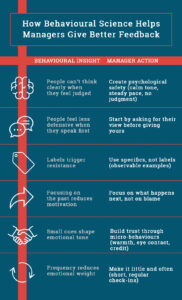
How Behavioural Science Helps Managers Give Better Feedback
Behavioural science explains what goes on inside a feedback conversation – and how you can help your managers use feedback as the powerful tool it is in any business or industry.
Here’s what behaviour science shows your managers need to do:
Create psychological safety
Threat turns the thinking brain off (think woolly mammoth and the overriding need to flee).
A manager who listens well, stays calm and avoids judgment helps the other person stay rational and receptive. High-stress environments do the opposite: they push people into defence mode.
Start by asking for their view
When your manager invites someone to reflect on their own performance first, the conversation becomes collaborative instead of corrective. People feel more ownership and less exposed.
Use specifics, not labels
General statements (“You need to be more proactive”) tend to trigger defensiveness. Concrete examples (“I noticed three client follow-ups didn’t happen last week”) keep the discussion grounded in fact.
Focus on what happens next
Future-focused conversations are more effective than post-mortems. They help people feel capable rather than criticised.
This is the heart of effective coaching – and why modern management training increasingly emphasises forward planning instead of backward scoring.
Build trust through micro-behaviours
Small actions make a big difference. Warm greetings, open posture, genuine eye contact, asking for input and giving credit all help the other person feel respected and safe. These micro-behaviours encourage staff to be receptive to the feedback.
Make it little and often
Short, regular conversations reduce the emotional weight of feedback. Behavioural science calls these feedback loops – and they reduce avoidable friction.
These elements form the basis of modern coaching management skills – and most managers benefit from practising them.
Managers Need to Receive Feedback Too
And one more thing…
We’ve all met managers who avoid hearing anything about their own performance. It’s usually due to fear. Fear of losing status, looking less competent or discovering something uncomfortable.
On the other hand, inviting feedback openly is a sign of maturity and feeling psychologically safe. “I’m trying a new approach; tell me how it’s working.”
You need this kind of maturity in your managers – and in your senior leadership team. It unlocks a culture where effective feedback flows more freely in every direction.
If you’re reading this, you may already have researched leadership and management training.
What Effective Management Training Looks Like Now
Modern management training and broader leadership development now focus on rehearsal, reflection, observation and coaching.
For this to lead to sustainable change, an experiential approach works best. New behaviour needs embedding in the moments shortly after the event.
Why? Because experience is a more powerful agent of change than explanation. Managers need to practise:
- Real conversations – the difficult ones, the awkward ones, the ones full of nuance – to realise how effective they can be.
- Giving both feedback as a manager and feedback to a manager higher up.
You can see how this takes more than a slide presentation or a pep talk. Insight from behavioural science plus practice time is the way forward.
Keystone Can Help When Your Managers Avoid Feedback
We’ve helped clients across the country in multiple sectors to find the right solutions for their unique needs. Your managers need to feel at ease offering and receiving effective feedback – so, if partnering with us to provide bespoke, high-impact training sounds a good fit for your organisation, let’s talk.

Esther Patrick is a Client Accounts Director at Keystone and a member of the Senior Leadership Team. An experienced consultant and management author, she has nearly 20 years’ experience leading client partnerships across sectors from construction to healthcare and designing leadership, culture, and team development programmes aligned with their strategic goals and values. Esther is passionate about creative, human-centred learning.