Why Respect in the Workplace Starts with Sexual Harassment Training for Managers
So far, you’ve been taking “reasonable steps” to prevent sexual harassment in your workplace. But from October 2026, the rules are more stringent. New sexual harassment law says you must take all reasonable steps. Not any steps, but all steps you possibly can.
To implement this, it’s likely your managers will need extra sexual harassment in the workplace training.
Why? Because in addition to this, you’re also going to be liable for third-party harassment of your employees. Many managers will not yet understand exactly how to meet this requirement.
And – by the time you read this – the April 2026 update to whistleblowing protections will also be in effect. Your employee who reports a sexual harassment incident is now legally protected.
Whistleblowing in these circumstances qualifies as a “protected disclosure”. The individual cannot be ignored or penalised in any way by managers wanting to protect their position.
We know you’re already aware of the problem around sexual harassment, sexual harassment law UK, and the workplace changes needed to solve it.
What you may not so easily realise is you can start addressing safety and respect in the workplace immediately by investing in sexual harassment training for all your managers.
What is Sexual Harassment in the Workplace?
Sexual harassment in the workplace is any unwanted behaviour of a sexual nature that violates someone’s dignity or creates an intimidating, hostile, degrading, humiliating or offensive environment.
It includes obvious misconduct, but also the everyday behaviours that are often overlooked: repeated comments, exclusion, or “banter” that crosses a line. Intent is not the deciding factor – impact is.
In practice, sexual harassment at work rarely appears as a clear-cut incident.
It tends to emerge in small moments, influenced by context, relationships, and how comfortable people feel speaking up.
Under sexual harassment law UK, what matters is not only what happened, but whether you took all reasonable steps to prevent it.
So, defining sexual harassment is not enough.
What matters for you now is whether your managers can recognise these situations in real time and respond appropriately when they arise – before the situation escalates.
What is the Role of First Line Managers in Preventing Sexual Harassment in the Workplace?
First line managers are the point at which your intention to prevent sexual harassment in the workplace either holds or fails. They set expectations day to day, respond to behaviour as it happens, and decide what gets addressed or ignored.
That makes them central to taking “all reasonable steps”.
Policies and leadership messages matter, but they’re not what employees experience. What they experience is how their manager reacts in the moment.
In practice, that role is not straightforward.
Managers must recognise early signs, step into difficult situations, handle complaints appropriately, and manage risk – often without clear guidance on where the line sits.
This becomes more complex when sexual harassment at work involves third parties, power imbalances, or behaviour that is ambiguous rather than overt. These are the situations where inaction is most likely, and where risk builds quickly.
If you expect your managers to take all reasonable steps, they need to know what that looks like in real situations.
Without that clarity, even well-intentioned managers hesitate – and hesitation is often where the problem escalates.
Why Sexual Harassment Training for Managers Is Essential to Taking All Reasonable Steps
If you expect your managers to take all reasonable steps, they need more than awareness. They need to know how to act. They need practical skills.
Sexual harassment training for managers turns your policy into practice. It gives them experience of where the line must sit, how to respond in the moment, and how to handle concerns without making the situation worse.
Otherwise, instinct or avoidance kicks in. Inconsistency appears. Risk builds.
Investing in sexual harassment in the workplace training equips your managers to act with confidence, consistency, and professionalism when it matters.
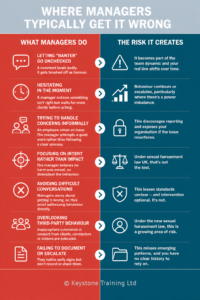
Where Managers Get It Wrong When Preventing Sexual Harassment in the Workplace
Letting “banter” go unchecked
A comment lands badly. It gets brushed off as humour. No one challenges it, so it becomes part of the team dynamic. Over time, your red line shifts.
Hesitating in the moment
A manager notices something isn’t right but waits for more clarity before acting. Behaviour continues or escalates, particularly where there’s a power imbalance.
Trying to handle concerns informally
An employee raises an issue. The manager attempts a quiet word rather than following a clear process. This discourages reporting and exposes your organisation if the issue resurfaces.
Focusing on intent rather than impact
The manager believes no harm was meant, so downplays the behaviour. Under sexual harassment law UK, that’s not the test.
Avoiding difficult conversations
Managers worry about getting it wrong, so they avoid addressing behaviour directly. This leaves standards unclear – and intervention optional. It’s not.
Overlooking third-party behaviour
Inappropriate comments or conduct from clients, contractors or visitors are tolerated because they’re from “outside” the team. Under the new sexual harassment law, this is a growing area of risk.
Failing to document or escalate
They notice early signs but don’t record or share them. This misses emerging patterns, and you have no clear history to rely on.
Most of these failures come from uncertainty rather than intent. But without the skills to act, managers cannot take all reasonable steps – and that’s where risk exposure increases.
Besides, left unaddressed, these patterns affect not just compliance, but retention, trust, and how safe your people feel at work.
How Does Sexual Harassment Training Build Respect in the Workplace?
Sexual harassment training builds respect in the workplace by giving managers the confidence and practical skills to recognise issues early, act consistently and address behaviour in a way that’s clear, fair, and aligned with your responsibility to take all reasonable steps.
In practice, that shift comes from how the training is delivered.
Managers need the chance to work through realistic scenarios – the ambiguous comments, the power imbalances, the third-party situations – not just the obvious cases.
They need to practise what to say, how to intervene, and how to handle a concern without escalating it or shutting it down.
Experiential learning is what makes the difference.
Safe practice, role play, safety conversations and structured feedback allow your managers to
- test their judgement
- see the consequences of different responses, and
- build confidence before they have to handle a real situation.
Done properly, sexual harassment training for managers moves beyond awareness. It builds consistency in how they handle behaviour. It reduces hesitation and reinforces what respect in the workplace actually looks like day to day.
Keystone’s Sexual Harassment Training for Managers Helps You Take All Reasonable Steps
If you expect your managers to take all reasonable steps, they need more than policy awareness. They need to be confident in how to act, what to say, and how to handle situations that are rarely clear-cut.
Keystone’s sexual harassment training for managers focuses on practical capability.
We work with your managers on real scenarios relevant to your business. This gives them the space to practise responses, build confidence and apply consistent standards across your workplace.
Investment in this kind of training gives you a more confident management layer, who lead respectful teams and reduce risk and discontent in your organisation.
If you want to strengthen how your business prevents sexual harassment in the workplace, get in touch and we’ll show you how this works in practice.

Esther Patrick is a Client Accounts Director at Keystone and a member of the Senior Leadership Team. An experienced consultant and management author, she has nearly 20 years’ experience leading client partnerships across sectors from construction to healthcare and designing leadership, culture, and team development programmes aligned with their strategic goals and values. Esther is passionate about creative, human-centred learning.