Safety Conversations That Actually Change Behaviour: How leaders create safe, high-trust environments (without more rules)
Click to download this article: Safety Conversations That Actually Change Behaviour
Most organisations we work with don’t have a knowledge problem when it comes to safety. How can leaders create safe, high-trust environments (without more rules)
People know the procedures.
They’ve completed the training.
They understand what “good” looks like.
And yet, in real work situations, behaviour doesn’t always follow. The typical response is to add more: more rules, more reminders, more toolbox talks.
But the gap isn’t usually about knowing what to do, because behaviour under pressure isn’t driven by knowledge. The COM-B model shows that behaviour is shaped by three interacting factors:
- Capability – Do I know what to do?
- Opportunity – Does the environment make it possible?
- Motivation – Do I feel able and willing to do it, right now?
Most safety interventions focus heavily on capability.
But when someone is working under time pressure, balancing competing priorities, or following what others around them are doing, opportunity and motivation often take over.
This is where safety conversations matter – they’re a way to understand what’s actually driving behaviour on the ground.
Why many safety conversations don’t change anything
In practice, many conversations still focus on correcting deviation:
“That’s not the correct procedure.”
“You need to follow the process.”
“Why didn’t you do it the right way?”
This reflects a traditional Safety-I approach – focusing on what went wrong. An alternative, drawn from Safety-II thinking, is to focus on how work is actually being done day to day, including the adjustments people make to get the job done.
That shift changes the conversation. Instead of asking:
“Why didn’t you follow the procedure?”
Leaders might ask:
“Talk me through what was happening at that moment.”
“What were you having to balance or deal with?”
This isn’t about lowering standards. It’s about understanding the conditions that shape behaviour so they can be addressed.
Behaviour is social, and often automatic
Two further patterns show up consistently in safety-critical environments:
- People tend to follow what others around them are doing, especially under pressure
- Repeated behaviours become habitual, requiring little conscious thought
Over time, this can normalise risk because the behaviour becomes part of “how things are done here”. Effective safety conversations bring these patterns into the open.
For example:
“What do most people tend to do in this situation?”
“Is this something that’s become the norm over time?”
They also reinforce the right behaviours in real time:
“That approach you took there – talk me through your thinking.”
“That’s exactly the standard we’re aiming for. Keep doing that.”
If people don’t feel safe to speak, risk stays hidden
Research on psychological safety shows that people are far more likely to raise concerns, admit uncertainty, or challenge unsafe behaviour when they feel safe to do so.
In environments where people expect blame, embarrassment, or dismissal, the opposite happens. You’ll fine issues go unspoken and shortcuts go unchallenged.
The tone of a safety conversation matters.
Leaders who ask open questions, listen properly, and respond constructively to what they hear are more likely to surface what’s really going on.
What effective safety conversations look like in practice
A simple structure that works well in operational settings is:
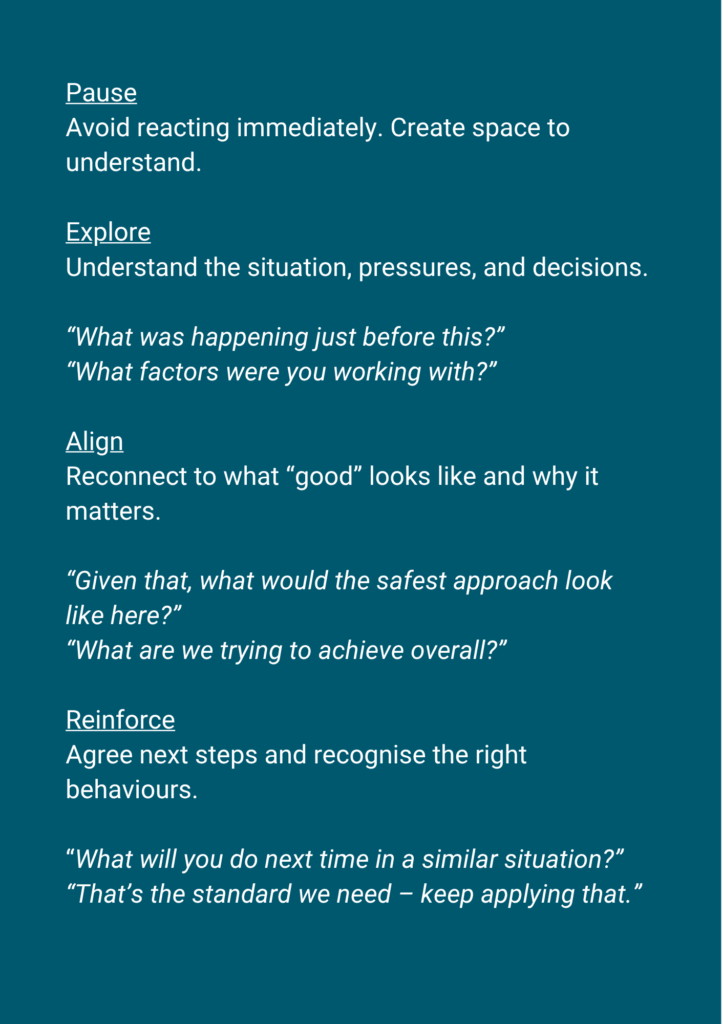
This kind of conversation identifies challenges, strengthens shared expectations, and helps to build individual judgement.
Where this often goes wrong
Even well-intentioned leaders can unintentionally limit impact by:
- Relying on telling and reminding, rather than exploring
- Treating unsafe behaviour as an individual issue, rather than a response to context
- Ignoring operational pressures that make safe behaviour harder
- Following up inconsistently, so expectations drift over time
Summary
Policies don’t create a safety culture. Culture is shaped in everyday interactions, especially the conversations leaders have when something doesn’t go to plan.
Handled well, those conversations can:
- Reveal what’s really driving behaviour
- Strengthen trust and openness
- Reinforce clear, consistent standards
- Support better decisions under pressure
Handled poorly, they can do the opposite
————–
Keystone Training Ltd works with organisations to strengthen safety leadership in real operational contexts, helping leaders understand behaviour, have better conversations, and embed safer ways of working over time.
If you would find it useful, we’ve created a short Leadership Development ROI Planning Framework to help you define behaviours, establish baselines and link development to measurable outcomes. It’s designed for use in budget and planning discussions.
Click to download the framework PDF (opens in a new window)

Jo Raishbrook - MInstLM
Jo Raishbrook is a Client Accounts Director at Keystone and a member of the Senior Leadership Team, where he leads client partnerships and develops programmes that deliver measurable culture and behaviour change. Drawing on a background in the performing industries and over 20 years’ experience in behavioural safety and leadership development, Jo brings creativity, realism, and deep sector understanding to every client engagement.