Employment Legislation Changes in the UK: Why Managers Need More Than New Policies
The Employment Rights Act 2025 has introduced some of the biggest changes to UK employment legislation in recent years:
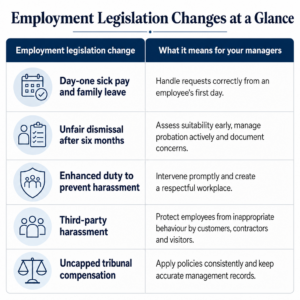
From April 2026, sick pay is payable from day one of absence, paternity and parental leave rights apply from day one of employment, and unfair dismissal protection begins at just six months’ service — with tribunal compensation now uncapped. The duty to prevent sexual harassment has been raised to an active, all-encompassing standard, and employers are now liable for harassment by third parties including clients and contractors.
While HR teams will naturally review policies and procedures to ensure legal compliance, much of the responsibility for applying the new legislation now rests with your line managers.
From probation reviews and absence conversations to family leave requests, performance management, and preventing workplace harassment, managers are expected to make fair, consistent, and well-documented decisions from the outset.
As changes to UK employment legislation continue to reshape your responsibilities, you need managers who understand not only what the law requires but also how to apply it confidently in everyday situations.
This change therefore calls for practical management skills that help leaders
- communicate clearly,
- set expectations,
- address concerns early and
- create workplaces where people feel respected, supported and treated fairly.
What Has Changed in UK Employment Legislation?
The Employment Rights Act 2025 introduces several significant changes that directly affect line managers. These include day-one rights for statutory sick pay and certain family leave, unfair dismissal protection after six months’ service, stronger duties to prevent workplace harassment, and greater accountability for how managers respond to everyday employee issues.
Why Does the Employment Rights Act 2025 Matter to Line Managers?
Many of the new legal responsibilities arise during everyday management conversations rather than formal HR processes.
Managers now need to recognise issues earlier, respond consistently, document decisions appropriately, and apply organisational policies fairly from an employee’s first day onwards.
How Can Managers Prepare for the New Employment Legislation?
Managers need practical skills alongside legal awareness. They should be able to:
- manage probation periods effectively
- conduct difficult conversations confidently
- respond appropriately to absence and family leave requests
- prevent inappropriate workplace behaviour
- document decisions clearly and consistently
- apply organisational policies fairly from an employee’s first day
How Employment Legislation Is Changing Everyday Management
The new legislation introduces new legal obligations – but it also changes the everyday situations where your managers need to make good decisions.
Many of the greatest risks arise not during formal disciplinary hearings, but during ordinary conversations that happen every day across your organisation.
Imagine a new employee approaching the end of a six-month probation period. Their manager has concerns about performance, but feedback has been informal, objectives have shifted, and very little has been documented.
Under the new legislation, there is far less time to identify concerns, support improvement, and make a fair, evidence-based decision about suitability.
The same principle applies to absence management. A manager who responds differently to similar situations because they know one employee better than another may believe they’re being flexible.
In reality, inconsistent decision-making can create unnecessary organisational risk if similar cases are not handled fairly and transparently.
Behaviour in the workplace presents another challenge. A comment dismissed as “just banter” by one manager may be recognised by another as inappropriate conduct or sexual harassment that needs addressing.
Your managers need the confidence to recognise where behaviour crosses the line, intervene early and create an environment where concerns are taken seriously before they become formal complaints.
In our experience working with organisations across a wide range of sectors, many managers have never been given the opportunity to develop these skills in a practical way.
They have little experience of documenting conversations effectively, handling challenging discussions consistently, or balancing empathy with accountability.
UK employment legislation has simply made those everyday management skills far more important than they were before. It’s the new operational reality you can’t ignore.
How Good Manager Development Turns Legal Requirements into Everyday Practice
The Employment Rights Act 2025 has raised the bar for what you should reasonably expect from your managers.
And if you expect them to meet this higher standard, they need the opportunity to develop the skills that support it.
The problem is that policy updates only define what’s required. They don’t help a manager respond confidently when an employee becomes emotional during a probation review, or when a complaint of inappropriate behaviour lands on their desk for the first time.
This is where practical manager development becomes essential.
Your managers need what’s called experiential learning – in other words, opportunities to rehearse difficult feedback conversations, receive constructive feedback, understand the consequences of different approaches, and develop the confidence to act consistently.
That confidence can’t be built by reading legislation or completing an online compliance module.
It develops through realistic practice, discussion, reflection and experience.
That’s the thinking behind Keystone’s Leading Others programme.
Rather than teaching employment legislation in isolation, it uses professional actor-facilitators and drama-based learning to help your managers gain the capability they’ll need to apply the law in everyday situations.
You can choose the full programme. But you also can select individual modules to strengthen specific areas where you feel there’s a lack of experience. For example, probation management, setting expectations, inclusive leadership, respectful workplaces or courageous conversations.
The legislation has set the standard. But it will always fall to your managers to make it happen.
How Keystone Helps You Develop Confident Managers
If you’re reviewing how the Employment Rights Act 2025 affects your organisation, it’s important to consider whether your managers have the confidence and practical skills to apply these new policies day by day consistently. That’s the real challenge here.
Our Leading Others programme is designed to help strengthen the areas where your managers will need the greatest support.
Help your managers lead with greater confidence and consistency.
Contact Keystone Training to discuss whether our Leading Others programme is right for your organisation.
FAQ
Do all managers need training on the Employment Rights Act 2025?
Every manager who supervises people should understand how the Employment Rights Act 2025 affects their day-to-day responsibilities. Many of the new requirements apply during routine management situations such as probation reviews, absence management, family leave requests, workplace behaviour concerns, and performance conversations.
Can we simply update our employment policies to meet the new legislation?
Updated policies are an important starting point, but they don’t prepare managers to apply those policies consistently in real situations. Managers need the confidence and practical skills to make fair decisions, document conversations appropriately and handle challenging situations in line with the law.
Can manager training focus on specific areas rather than a full programme?
Yes. Many organisations choose targeted development to strengthen particular management skills, while others prefer a broader programme covering the full range of responsibilities introduced by the new legislation. The right approach depends on your managers’ experience and the capability gaps you want to address.

Esther Patrick is a Client Accounts Director at Keystone and a member of the Senior Leadership Team. An experienced consultant and management author, she has nearly 20 years’ experience leading client partnerships across sectors from construction to healthcare and designing leadership, culture, and team development programmes aligned with their strategic goals and values. Esther is passionate about creative, human-centred learning.