How to Design a Leadership Development Programme That Changes Behaviour in Your Business
A leadership development programme should help leaders change how they perform in the workplace – not simply increase what they know.
Yet it’s so common to find you’ve invested in supposedly good leadership training courses, seen positive feedback forms, and then watched old habits return within weeks.
The problem is rarely the content itself. It can read well and still not deliver.
Most programmes fail because they focus on knowledge transfer rather than behaviour change.
Your leaders leave with new ideas but return to the same meetings, pressures, expectations and routines that shaped their previous behaviour. Something didn’t gel with what they actually have to do on a daily basis.
If you’re considering leadership development courses for your organisation, the best question isn’t what is leadership development? but what do you want your leaders to do differently?
That answer should shape every aspect of the programme you choose.
In our experience, the following are the three main aspects of any leadership development that changes behaviour.
1 Start With the Behaviours You Want to See
Many organisations begin leadership development by identifying skills, competencies or broad leadership qualities. While these areas matter, they can be difficult to translate into day-to-day action.
Terms such as “better communication”, “stronger coaching” or “more strategic thinking” sound positive, but they don’t describe observable behaviour. “Runs weekly 20-minute coaching” does.
Instead, focus on what you need your leaders to do differently.
For example, you may want managers to delegate more effectively, involve their teams in decision-making, or provide clearer feedback. These behaviours can be observed, practised and measured.
If you cannot describe the behaviour you want to observe, you cannot design a programme to develop it.
This is one reason generic management courses for leaders often struggle to deliver lasting results. They must appeal to a wide audience, which makes it difficult to focus on the specific leadership behaviours that matter most within your organisation.
Effective leadership development begins with your business objectives, your culture and the challenges your leaders face every day.
2 Design the Leadership Development Programme Around the Reality of Your Business
Leadership behaviour exists in a context. Your context.
Even highly motivated leaders will struggle to sustain new behaviours if their environment pushes against them.
For example, a programme may encourage leaders to coach rather than direct. Yet if workloads leave little time for meaningful conversations, or if performance rewards speed above development, they may revert to giving instructions rather than building team skills.
Successful leadership development programmes recognise that leadership behaviour is shaped by systems, expectations and workplace culture as much as individual capability.
Even small adjustments can make it easier for leaders to apply what they’ve learned consistently. For example, you may need to review:
- meeting structures,
- performance conversations,
- accountability measures,
- management expectations or
- opportunities for peer learning.
Leadership development should always reflect the reality of your organisation rather than an idealised version of it. They don’t work in a laboratory.
The closer the programme aligns with your real workplace challenges, the more likely your desired leadership behaviours will stick.
3 Build Guided Practice, Feedback and Repetition into Your Leadership Training Course
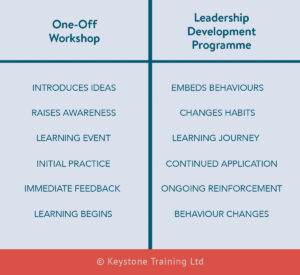
A workshop is an event. A leadership development programme is a process.
One-off workshops can introduce valuable ideas. But awareness alone rarely changes behaviour on the floor or out in the field.
Most leaders quickly understand what good leadership looks like when they stop and consider. The challenge lies in doing it when the moment of truth arrives.
The solution to the kind of real behaviour change you’re looking for lies in practice, feedback and repetition. In other words experiential learning.
That means leaders need opportunities to test new approaches, reflect on outcomes and refine their skills over time.
This, in turn, means you need to provide support between sessions – and encouragement to apply their learning in real situations rather than leaving it in the training room.
For example, consider a leader learning how to provide more developmental feedback for a team member.
A single workshop may explain the principles and offer some practice. However, real progress happens when that leader uses the approach with team members, receives feedback on what worked, adjusts their technique, and repeats the process over several weeks or months.
This sustained approach creates the conditions for genuine behavioural change.
So, when considering how to create a leadership development programme, look for opportunities to build practical application into the learning journey. Real scenarios, workplace projects, coaching conversations, peer discussion and structured reflection all help leaders embed new behaviours more effectively.
Changed behaviour is the real evidence of impact and a solid return on your investment.
Questions to Ask Before Choosing Leadership Development Programmes
Not all providers take the same approach to leadership development. Before investing in a programme, consider asking the following questions:
Which leadership behaviours will this programme develop?
A clear answer demonstrates that the provider focuses on outcomes relevant to you – after initial discussion – rather than content alone.
How will the programme reflect our organisation?
Your leaders operate within a unique environment. Whether that’s construction, engineering, manufacturing or any other industry, your specific environment has unique aspects. The programme should acknowledge your challenges, priorities and culture.
How will participants apply their learning between sessions?
Behaviour only changes when leaders use new skills in real situations, not when they simply attend training events. Ask about between-session experiments and bringing feedback.
How will progress be measured?
Look beyond attendance figures and satisfaction scores. Ask how the provider will assess behavioural change and business impact.
What support exists after the formal learning ends?
Sustained development requires reinforcement. Coaching, follow-up activities and structured reflection often play an important role.
The answers to these questions can help you distinguish between a training event and a leadership development programme designed to create lasting change.
Keystone Builds Leadership Development Programmes Around Real Behaviour Change
At Keystone, we believe leadership development should deliver measurable improvements in workplace performance and a return on your investment.
Our bespoke programmes begin with your organisation, your objectives and the behaviours you want leaders to demonstrate more consistently.
From there, we design learning journeys that combine practical application, reflection, feedback and reinforcement.
We also offer recognised ILM and CMI accredited leadership development programmes. These give participants the opportunity to gain respected qualifications while developing skills that actually make a difference in their day-to-day roles.
Whether you’re exploring what leadership development is, reviewing existing leadership training courses or looking for a management development programme for businesses that need measurable results, our focus remains the same: helping leaders turn learning into action.
Talk to Us About Building a Programme Around Your Business
Every organisation faces different leadership challenges. The behaviours that drive success in one business may not be the same in another.
Talk to Keystone about building a leadership development programme around your business, your people and the outcomes you want to achieve. You can speak to one of our leadership facilitators today.
If you would find it useful, we’ve created a short Leadership Development ROI Planning Framework to help you define behaviours, establish baselines and link development to measurable outcomes. It’s designed for use in budget and planning discussions.
Click to download the framework PDF (opens in a new window)

Esther Patrick is a Client Accounts Director at Keystone and a member of the Senior Leadership Team. An experienced consultant and management author, she has nearly 20 years’ experience leading client partnerships across sectors from construction to healthcare and designing leadership, culture, and team development programmes aligned with their strategic goals and values. Esther is passionate about creative, human-centred learning.