How Can Organisations Build a Learning Culture That Lasts All Year?
A lasting learning culture builds from the way managers lead, how people share knowledge and the opportunities you give employees to keep developing throughout the year.
Every May, organisations across the UK take part in Learning at Work Week. Run by the Campaign for Learning, it encourages employers to celebrate learning and think about how people develop at work. It’s a valuable initiative and often sparks fresh ideas.
When discussing training and development with clients, we’re often asked: “Why Is Learning at Work Week not enough on its own?
The answer is: we’ve found that the real business challenge comes afterwards.
Why?
Because if learning slips back down the priority list until the following year, very little changes. Skills fade. Good intentions disappear. And your teams run the risk of returning to their same old habits.
After all, they’ve exercised those habits 51 weeks of the previous year!
That’s why ongoing employee training makes the biggest difference.
So how can you bring this about in your organisation?
How Can Organisations Build a Continuous Learning Culture?
When people ask what is work culture, they often think about values on a wall or the atmosphere in the office. A learning culture goes much deeper. It shapes how people solve problems, respond to feedback and improve the way they work.
If you want to know how to improve work culture, start by looking at what happens every day rather than what appears in your training calendar:
- Do your employees ask questions without worrying how they’ll be judged?
- Do managers make time for development conversations?
- Are new ideas welcomed, tested and discussed?
If the answer is yes, learning has become part of normal working life rather than an occasional event.
That doesn’t happen by chance.
It needs clear expectations, visible support from leaders and enough time for people to learn while doing their jobs.
What Makes Workplace Learning Stick?
Many organisations provide excellent workplace training and development opportunities. But what happens next determines whether people actually change the way they work.
People remember far more when they can use their new knowledge quickly – with opportunities to practise, receive feedback and reflect on what worked. Embed it, not just hear about it.
This is the crux of workplace behavioural change.
Think about someone learning to coach colleagues more effectively. Learning about coaching techniques in a special week is useful, but confidence grows through experimenting, feedback from others and repeated practice. Over time, those behaviours then become part of the way they lead.
In short, learning sticks when people apply it, discuss what worked well or not so well, and build regularly on the insight gained.
How Can Employers Encourage Learning Throughout the Year?
Our experience is that learning culture needs structure as well as enthusiasm.
You could, for example, set learning goals alongside business goals. Give people protected time to develop new skills. Encourage teams to share ideas after projects or customer meetings instead of moving straight on to the next task.
It’s also helpful to make opportunities to ask people what they’ve learned this month.
Some companies find it works well to regularly celebrate improvements, not just results. This is a great incentive. People are more willing to learn and try out new approaches when every attempt isn’t treated as a pass-or-fail exercise.
You can also invite employees to share useful articles, books or practical techniques with colleagues.
These activities cost very little, yet they reinforce the message that learning matters throughout the year. It stops feeling like an annual event and becomes part of everyday work.
How Can Digital Learning Support Employee Development?
Modern digital learning solutions make continuous development much easier to manage.
A good digital learning platform gives people access to relevant learning when they need it and have time for it – rather than waiting for the next scheduled course. Your employees can work through content at their own pace and revisit key topics when circumstances change.
That flexibility is valuable – but technology is only part of the answer.
On top of that, you need a strong digital learning team that helps you choose content that reflects your goals and your challenges. They’ll design meaningful learning pathways and measure whether your people are applying what they’ve learned.
And on top of that, digital learning also works best when it supports relevant conversations between your managers and your employees. Digital opportunities aren’t meant to replace the shared learning culture.
What Role Do Managers Play in Creating a Learning Culture?
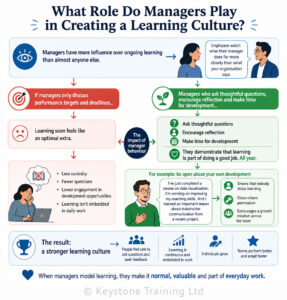
Your managers have more influence over ongoing learning than almost anyone else.
Employees watch what their manager does far more closely than what your organisation says.
If managers only discuss performance targets and deadlines, learning soon feels like an optional extra.
But managers who ask thoughtful questions, encourage reflection and make time for development send a different message. They demonstrate that learning is part of doing a good job. All year.
For example, they can be open about their own development. A manager who talks about a course they’ve completed, a skill they’re improving or a lesson they learned from a project shows that nobody reaches a point where they stop learning.
This gives others permission to ask questions, seek feedback and keep improving themselves.
If your managers lack confidence, investing in their development is often the best first step. Some of your technical experts may not have had the training to be a natural manager, for example.
Confident managers bring many benefits to your organisation, including leading the culture of continual learning.
What Are the Benefits of a Learning Culture in the Workplace?
Building a learning culture in your organisation is a longer-term investment. You don’t see results in one week or one month. But over time, you see the value in higher productivity, stronger performance and better retention.
- People become more confident when tackling unfamiliar problems.
- Managers spend less time solving issues that others could handle themselves.
- Teams adapt more quickly when priorities change because learning has already become part of the way they work.
- A strong learning culture also helps organisations retain knowledge. Experienced employees share what they know instead of keeping it to themselves, making it easier for others to grow into new roles.
Perhaps most importantly, learning becomes something your people enjoy. People who keep learning are more likely to stay engaged, contribute fresh ideas and build confidence in their own abilities.
Building a Learning Culture with Keystone Training
Creating a learning culture takes more than a calendar of courses.
It means designing ongoing learning that fits your organisation, supports the real behavioural change you need, and gives your people opportunities to develop throughout the year.
At Keystone, we create learning solutions that help you turn learning into lasting performance improvement.
From tailored learning experiences to behavioural change training, we work with you to build development programmes that continue delivering value long after Learning at Work Week has finished.
Ready to build a learning culture that delivers lasting results?
Contact Keystone Training to discuss the right development programme for your organisation.

Esther Patrick is a Client Accounts Director at Keystone and a member of the Senior Leadership Team. An experienced consultant and management author, she has nearly 20 years’ experience leading client partnerships across sectors from construction to healthcare and designing leadership, culture, and team development programmes aligned with their strategic goals and values. Esther is passionate about creative, human-centred learning.