How Leadership Development Training Improves Decision Making and Business Outcomes
Leadership development training can have a direct impact on how your people make decisions, especially when the pressure is on.
This matters for revenue. There’s a cost attached when decisions start slowing down, become cautious or lose clarity.
That cost shows up in missed opportunities and weaker results. But it’s not always noticed immediately as a decision-making issue.
Maybe a leadership team revisits the same issue for the third time, a manager escalates decisions they should own, or different departments pull in slightly different directions.
When you do realise what’s happening, it’s frustrating. But this is where leadership development training earns its value. The right development helps leaders think more clearly, make better decisions and stay aligned to your business goals when the stakes are high.
On the other hand, poor decision making affects your commercial outcomes.
Why Poor Decision Making Quickly Becomes a Business Problem
Once hesitation or inconsistency appears in leadership behaviour, the effects move quickly through your business.
Why? Because decisions take longer, get reopened, or lack clear ownership. Priorities tend to alter. Teams second-guess direction or wait for further approval. Pace slows and accountability weakens.
However, by the time poor decision making shows up in missed opportunities or delays, your leadership problem has usually been there for some time.
Commercial pressure is often one factor that contributes to the problem.
Pressure Changes the Way Leaders Think and Act
Pressure changes how people make decisions. Or avoid making them.
Even experienced leaders can become more cautious, more reactive, or more reliant on habit when the pressure of commercial reality raises the stakes.
For example, leaders under pressure can snap to judgements prematurely.
Quality of discussion in their teams then drops. No one likes to challenge openly. Assumptions go untested. And hierarchy or urgency rather than clear judgement shapes decisions.
The result is slower, weaker decision making.
Leadership development training becomes valuable here, because it helps leaders recognise these patterns and improve how they think, communicate and take ownership under pressure.
Let’s look more closely at that claim and see why it holds up.
How Leadership Development Training Improves Decision Quality
Effective leadership development training improves decision making by changing what leaders do in the moments that matter.
You don’t want your people to have a model to remember or a theory to discuss. You want them to think more clearly, communicate more effectively and make better judgements when pressure, ambiguity or risk arise.
And that starts with awareness.
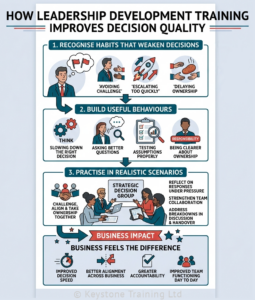
Leaders need to recognise the habits that weaken decision quality, including:
- Avoiding challenge
- Escalating too quickly
- Delaying ownership
- Relying too heavily on instinct
Once those patterns become visible, they’re much easier to address.
From there, good leadership development training helps leaders build more useful behaviours.
In practice, that might mean slowing down the right decision process instead of rushing it, asking better questions before committing, testing assumptions properly or being clearer about who owns what next.
Over time, those habits improve speed, alignment and accountability across your business.
These are not abstract leadership qualities. They’re practical habits that affect how well your team functions day to day.
And the opportunity to slow down and think is rarely available in daily work situations. Nor is the opportunity to practise safely using relevant scenarios.
This is where the best leadership training courses differ from generic development.
Strong programmes create opportunities for your leaders to practise decision making in realistic situations, reflect on how they respond under pressure, and strengthen the decision making they bring back into your business.
This is experiential learning.
In some organisations, that practice happens within a strategic decision group, where leaders strengthen how they challenge, align and take ownership together rather than in isolation.
That matters, because poor decisions rarely fail on individual judgement alone. More often, they break down in discussion, handover or unclear accountability between people.
In that sense, well-designed leadership development training also improves how your leadership teams operate together.
When leaders become better at making decisions clearly, constructively and consistently, your business will feel the difference quickly.
The Qualities of a Good Leader Are Clearest When the Decision Stakes Are High
It’s easy to talk about the qualities of a good leader in broad terms. They’re much easier to recognise when a difficult decision has to be made.
Can someone stay clear-headed? Do they weigh risk properly or are they risk-averse? Can they invite challenge without losing direction, and make a decision that others can understand and act on?
Qualities such as judgement, accountability, self-awareness and composure matter because they shape how decisions are made in practice.
A leader doesn’t need to have every answer, but they do need to create enough clarity and confidence for the business to move forward.
Good leadership development training is effective because it strengthens the behaviours that sit behind good decision making. It never assumes those qualities will appear naturally with seniority or experience.
For example, when you promote someone internally without leadership training, gaps in judgement or confidence can quickly become a problem – especially under pressure.
Leadership vs Management Becomes Obvious in High-Stakes Decisions
The difference between leadership vs management often becomes clearest when the answer is not obvious.
Management is essential for structure, consistency and delivery. It keeps work moving and helps organisations operate effectively.
But leadership is tested more visibly when there’s ambiguity, pressure or trade-off involved.
That’s when someone has to make sense of uncertainty, hold your business goals steady and help others move forward with confidence.
Being expected to make increasingly strategic decisions without support and training, as we indicated above, can leave a gap between responsibility and readiness.
A good training course on leadership helps close that gap.
It gives your managers the opportunity to strengthen the skills they need when their role requires more than operational control.
Better Leadership Decisions Lead to Better Business Outcomes
Better decisions improve what happens after the meeting’s over.
When leaders make clearer, more timely and better-judged decisions, work moves faster.
Teams understand priorities more easily. Accountability becomes stronger because employees are clearer on what’s been agreed and who owns it.
Over time, that affects business performance in very practical ways.
Delays happen less often, employees use resources more effectively, and cross-functional working becomes less frustrating.
The result is not only better leadership behaviour, but better business outcomes for you – exactly what return on investment demands.
That’s why leadership development training is worth taking seriously. If your organisation wants stronger performance, it makes sense to look closely at the quality of the decisions your leaders are making every day.
Keystone Leadership Development Training Helps Leaders Improve Decision Making
If decisions in your organisation are becoming slower, less consistent or harder to act on, it may be a sign that your leaders need better support in how they think, communicate and take ownership under pressure.
Bespoke leadership development training can make a measurable difference.
At Keystone, we start by understanding how your business works, where decision making is breaking down, and what your leaders need in practice.
From there, we design leadership development training that helps your people lead with more clarity, accountability and confidence.
If you’d like us to partner with you to design bespoke training that will equip your leaders long-term, give us a call today and let’s discuss your unique needs.
If you would find it useful, we’ve created a short Leadership Development ROI Planning Framework to help you define behaviours, establish baselines and link development to measurable outcomes. It’s designed for use in budget and planning discussions.
Click to download the framework PDF (opens in a new window)

Esther Patrick is a Client Accounts Director at Keystone and a member of the Senior Leadership Team. An experienced consultant and management author, she has nearly 20 years’ experience leading client partnerships across sectors from construction to healthcare and designing leadership, culture, and team development programmes aligned with their strategic goals and values. Esther is passionate about creative, human-centred learning.