Why Do High Performing Employees Struggle When They Become Managers?
High performers don’t automatically make successful first-time managers. The skillset is different. The way of working very different.
Promoting a high performer into management often feels like the obvious next step. They’ve demonstrated commitment, delivered results and earned the respect of colleagues. Surely they’ll become a successful first-time manager too?
Unfortunately, that’s often not what happens.
The qualities that help someone excel in a technical, operational or professional role are rarely the same ones needed to lead people.
Many organisations can therefore – unintentionally – promote employees into management without preparing them for what’s a very different job.
The result can be disconcerting for everyone:
- The new manager experiences high daily levels of frustration.
- The team lives with uncertainty instead of confident direction.
- Your business starts missing opportunities you thought were within reach.
But new managers can learn these skills.
With the right leadership and management development programme, we’ve proved new managers do gain the confidence and practical abilities to perform as you’d hoped.
Which Skills Do First-Time Managers Commonly Lack?
First-time managers often need to learn how to delegate, communicate clearly, give constructive feedback, manage performance, make decisions, resolve conflict and motivate different individuals within a team.
These are mostly people skills. Your new manager knows your business and your goals. They’re already high performers.
But as a first-time manager, they can struggle because they haven’t yet developed the people skills needed to lead others effectively. (As Forbes points out, the future of leadership is in practice, not theory. We totally agree.)
These missing skills affect everyday situations related to productivity, engagement and business performance.
Let’s unpack a few examples to show what we mean:
The team lacks guidance
A newly promoted production supervisor may continue solving every technical problem personally because that’s how they built their reputation. The team soon learns to wait for answers instead of finding solutions themselves.
Poor performance isn’t challenged
An experienced engineer might hesitate before addressing poor performance because their proven expertise has never required difficult conversations. Small problems then become larger ones.
Team development goes on hold
A successful project co-ordinator may continue focusing on completing their own work instead of creating the conditions for everyone else to succeed. They remain busy, but the team doesn’t develop and your business becomes increasingly dependent on one individual.
The same promotion pattern appears across many sectors – with the same possible lack of leadership and management skills.
Healthcare professionals become clinical leads. Sales executives become sales managers. Accountants become finance managers. Experienced administrators begin supervising colleagues.
Their previous success proves they understand the work. But it doesn’t automatically prepare them to lead the people doing it.
Management also requires the skill of taking a wider perspective.
Instead of asking, “How do I complete this task?” managers must begin asking, “How do I help the team achieve this objective?”
Instead of being measured only by personal performance, they’re now responsible for
- developing capability,
- maintaining standards,
- supporting wellbeing and
- delivering business results through other people.
That’s a significant change of skill set for any first-time manager and one that directly influences team performance.
How Can Leadership and Management Development Improve the Transition?
Leadership and management development improves the transition by giving new managers the practical skills, confidence and support they need before poor habits become established.
As a successful organisational leader, you probably recognise that management isn’t something you can leave to trial and error.
First-time manager training makes the transition for your new manager easier for them (in the short term) and more effective for you (in the longer term).
How?
By giving them practical tools they can apply immediately while helping them build confidence in their new role.
Most people like to feel they have a grasp on what they’re doing rather than working in the dark. Practical tools to use right away increase that grasp – although, obviously, expertise develops over time.
But different organisations will benefit from different approaches to leadership and management development.
So what are your choices to help new managers develop the necessary skills?
Digital or e-learning
If your managers need a consistent foundation across several teams, sites or departments, digital learning provides the same high-quality starting point for everyone. It also gives managers the flexibility to revisit key topics as they develop in the role.
Live workshops
Where managers will benefit from discussing real-world situations with colleagues, live workshops encourage shared learning, practical discussion and immediate feedback. First-time manager training helps them explore different approaches before returning to the workplace.
Coaching
When individual managers need support as they grow into leadership, coaching provides time to reflect on genuine workplace challenges and develop practical solutions with expert guidance.
Drama-based learning
If managers need to build confidence in conversations that can’t be learnt from a handbook, drama-based learning allows them to practise realistic situations in a safe environment before facing them at work.
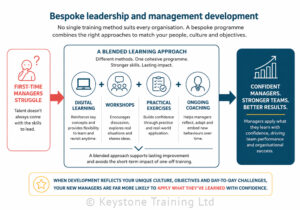
Bespoke leadership and management development
No single training method suits every organisation. That’s why many businesses choose a bespoke development programme that combines several approaches to match their people, culture and objectives.
Digital learning reinforces key concepts. Workshops encourage discussion. Practical exercises build confidence. Ongoing coaching helps managers embed new behaviours as they develop.
This blended learning approach to first-time manager training supports lasting improvement rather than relying on a single training event that’s quickly forgotten.
When leadership and management development reflects your organisation’s unique culture, goals and day-to-day challenges, your new managers are far more likely to apply what they’ve learned with confidence.
Why Technical Experts Face a Particularly Difficult Transition
Although every first-time manager faces new challenges, technical experts often experience an additional hurdle.
Throughout their careers, they’ve been recognised because they know the answers. They’ve solved problems that others couldn’t. Their expertise has become part of their professional identity.
Management changes that expectation.
People now look to them for guidance, support and judgement rather than technical solutions alone.
Success comes from helping other people find their own answers, not immediately stepping in.
That can feel difficult for technical experts. And it takes longer.
Developing their leadership skills as soon as possible helps them make that transition successfully. They retain their valuable expertise while learning when to coach, when to delegate and when to step back so their team can grow.
For both individuals and organisations, that’s where the real value of management begins – when good leadership enables your teams to develop.
FAQ
How long does it take for a first-time manager to become confident?
There’s no fixed timescale. Some managers adapt quickly, while others need more support as they take on responsibility for people rather than tasks. Structured management development can shorten the learning curve and help new managers avoid developing ineffective habits.
Should leadership and management training begin before promotion?
Yes, where possible. Preparing high-performing employees before they become first-time managers helps them understand the expectations of leadership and gives them practical skills they can use from day one.
What’s the best type of leadership and management development for first-time managers?
The best approach depends on your organisation, your managers and the skills they need to develop. Many organisations achieve the strongest results through a bespoke (rather than off-the-shelf) blended programme that combines digital learning, workshops, coaching or other practical learning methods.
Keystone Helps Your First-Time Managers Succeed
Supporting new managers and preparing your high performers for promotion is an investment that strengthens your management long after the promotion itself.
The earlier they develop the right leadership and management skills, the sooner they begin building confident teams and delivering stronger business performance.
Whether your organisation needs digital learning, practical workshops, coaching, drama-based learning or a bespoke development programme, Keystone can help you choose the right approach.
We’ll help you identify the leadership skills your new managers need most and recommend a development solution that suits you. Call us today or email us to schedule a good time for you.

Esther Patrick is a Client Accounts Director at Keystone and a member of the Senior Leadership Team. An experienced consultant and management author, she has nearly 20 years’ experience leading client partnerships across sectors from construction to healthcare and designing leadership, culture, and team development programmes aligned with their strategic goals and values. Esther is passionate about creative, human-centred learning.