How Can Managers Create Accountability Without Micromanaging?
Managers create accountability without micromanaging by setting clear expectations, agreeing how performance will be measured and giving people enough autonomy to deliver.
If you’re responsible for developing managers in your organisation, the challenge is to make sure they know how to maintain standards and address problems without constantly checking, controlling or stepping into their team’s work.
Here, we’ll look at why managers slip into micromanagement, how to recognise the warning signs and how management development can help them build accountability and trust instead.
Table of contents
What Is Micromanagement?
Why Do Managers Micromanage?
What Are the Signs of Micromanagement at Work?
Is Micromanaging Bullying?
How Does Micromanagement Affect Business Performance?
How Can Management Development Improve Accountability and Trust?
What Is Micromanagement?
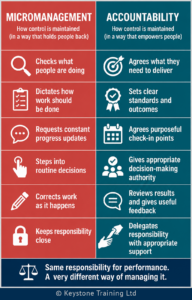
Micromanagement is a management style where someone exercises excessive control over how their team works. They focus too closely on individual tasks and decisions rather than giving people appropriate responsibility for delivering agreed outcomes.
There’s a difference between this and good management.
Asking why a deadline has been missed is management. Checking the work of someone who needs additional support is management. Agreeing regular progress updates on an important project is management.
The problem starts when oversight becomes unnecessary control, and capable employees are given too little freedom to do the jobs they’ve been employed to do.
There are no excuses, but there are often reasons that explain why it happens.
Why Do Managers Micromanage?
Managers don’t necessarily set out to micromanage. Sometimes their behaviour develops because they’ve never really understood what being a manager involves.
Equally, a high-performing employee who’s been promoted may still believe their value comes from being the expert. Or maybe they’re insecure in the new role or find it difficult to accept work being done differently from the way they’d do it themselves
Organisational problems can contribute too:
If your managers have no meaningful KPIs or clear measures of performance, how do they know if their people are delivering? Watching activity can become a substitute for measuring outcomes.
Hybrid working can expose the same problem. A manager who felt in control because they could literally see the team may respond to reduced visibility with more messages, meetings and requests for updates.
There can also be less comfortable reasons. A manager may fear being overshadowed by a team’s high performer or worry about failing to meet the expectations of their own manager.
Poor communication within the team can add another layer of uncertainty.
Why does understanding the cause matter?
Because simply telling someone to stop micromanaging may do little to change their behaviour.
What Are the Signs of Micromanagement at Work?
The signs of micromanagement may reach you before anyone uses the word itself.
You might notice that your employees:
- Feel they can’t make decisions
- Have to wait for one manager’s approval before routine work can progress
- Become reluctant to take initiative despite being capable.
- Complain among themselves
- Take sick leave more often
- Resign with greater frequency from one team
What Does Micromanagement Look Like in Practice?
The behaviour will not look identical in every workplace.
In a manufacturing business, an experienced supervisor might be told to refer routine operational decisions upwards – even though they have the knowledge and authority to make them. Production slows while the manager becomes an unnecessary bottleneck.
In a hybrid professional team, employees might be expected to report repeatedly on what they’re doing throughout the day. The manager gains visibility of activity but loses time that could have been spent discussing progress, priorities or problems.
In a customer-facing organisation, experienced employees might have to seek approval for routine decisions that could have resolved a customer’s problem immediately. This affects service quality and customer relationships.
These are the kinds of patterns that you need to recognise if you’re responsible for management capability.
Is Micromanaging Bullying?
We’re sometimes asked whether micromanaging amounts to bullying.
Micromanagement is not automatically bullying. A manager may be controlling because they lack confidence or management skills rather than because they intend to intimidate an employee.
However, persistent scrutiny, undermining someone’s judgement, unreasonable demands or repeatedly singling out an individual can cross the line into bullying behaviour.
Behaviour directed at someone because of race, sex, disability or another protected characteristic can raise separate and potentially serious concerns about discrimination or harassment.
Whatever its cause, though, repeated complaints that people feel watched, undermined or unfairly treated should not simply be dismissed as a manager having a particularly ‘hands-on’ style.
How Does Micromanagement Affect Business Performance?
As trust and initiative decline, the consequences begin to show in team – and ultimately business – performance.
Left unchecked, that can begin to shape the wider culture of your organisation.
Why?
Because employees stop solving problems independently. Decisions take longer. Over time, some people may disengage while good employees may decide to leave.
Micromanagement can also restrict your company’s growth.
A business development manager, for example, may see opportunities delayed because internal decisions cannot be made quickly enough.
And a manager in business development who spends too much time checking every detail of their team’s work has less time for customers, relationships and future opportunities.
Overall, micromanagement affects your organisation’s ability to use its people well, respond quickly, and grow without every decision depending on a small number of managers.
The alternative is to create genuine accountability without micromanaging – and that requires managers to have the right skills.
How Can Management Development Improve Accountability and Trust?
Management development can give your managers practical alternatives to excessive control. Instead of asking them simply to ‘let go’, you can help them learn how to:
- Set expectations
- Measure performance
- Delegate effectively
- Hold constructive conversations when something goes wrong
Developing these skills gives managers practical ways to maintain accountability without falling back on over-control.
Set Expectations and Measure What Matters
People can only be accountable when they know what they’re accountable for.
Managers need to establish responsibilities, expected standards and appropriate measures of performance.
This gives them something objective to work from, rather than relying on their own impressions of how an employee is performing.
Clear KPIs are only part of the process though. Accountability isn’t created by a dashboard alone!
Your managers also need the skills to discuss performance with team members, give useful feedback and address problems early.
These are skills that managers can develop through programmes grounded in behavioural science, with opportunities to practise them safely.
Give Managers the Confidence to Delegate
Delegation requires judgement.
Managers need to decide what someone is ready to take responsibility for, what support they may need and when progress should be reviewed.
That means accepting that another capable person may approach a task differently. If a manager delegates the work but continues dictating every step, responsibility hasn’t really moved at all.
Good management development lets managers practise these decisions and understand how their role changes as members of their team become more capable.
Time away from the work environment gives your managers a safe place to practise. Using scenarios based on your real workplace challenges, with feedback from facilitators and peers, they can learn when and how to delegate – and when to trust their team to work independently.
Build Communication Without Constant Checking
Regular communication matters, particularly when people work remotely or across different locations. But more communication isn’t necessarily better communication!
Good development training can help managers who tend to micromanage:
- Recognise and communicate sensible check-in points.
- Ask relevant questions that reveal whether support is needed.
- Create regular opportunities for employees to raise concerns themselves when they have them.
Interactive training with professional actor-facilitators gives managers the opportunity to practise these conversations and experience how different approaches work.
With these skills in place, your managers gain the visibility they need without requiring a continuous stream of updates. They can maintain appropriate oversight without creating the wider business risks that micromanaging can bring.
Keystone Helps Managers Achieve Accountability Without Micromanaging
Ultimately, accountability without micromanaging depends on managers knowing when to set direction, when to support, when to challenge and when to get out of the way.
For your business, those are important management skills.
When your managers have the skills and confidence to create genuine accountability, your people have room to develop. Your managers can concentrate on the work only they should be doing. And trust has a much better chance to grow.
If micromanagement sounds like an issue that’s affecting the managers in your organisation, we’re happy to discuss exactly which kind of management programme would best fit your needs and support your business success.
Call us today or email us to schedule a good time for you.

Esther Patrick is a Client Accounts Director at Keystone and a member of the Senior Leadership Team. An experienced consultant and management author, she has nearly 20 years’ experience leading client partnerships across sectors from construction to healthcare and designing leadership, culture, and team development programmes aligned with their strategic goals and values. Esther is passionate about creative, human-centred learning.